They’re Running AI On Human Brain Cells
AI copied the brain. Now researchers are trying the real thing.
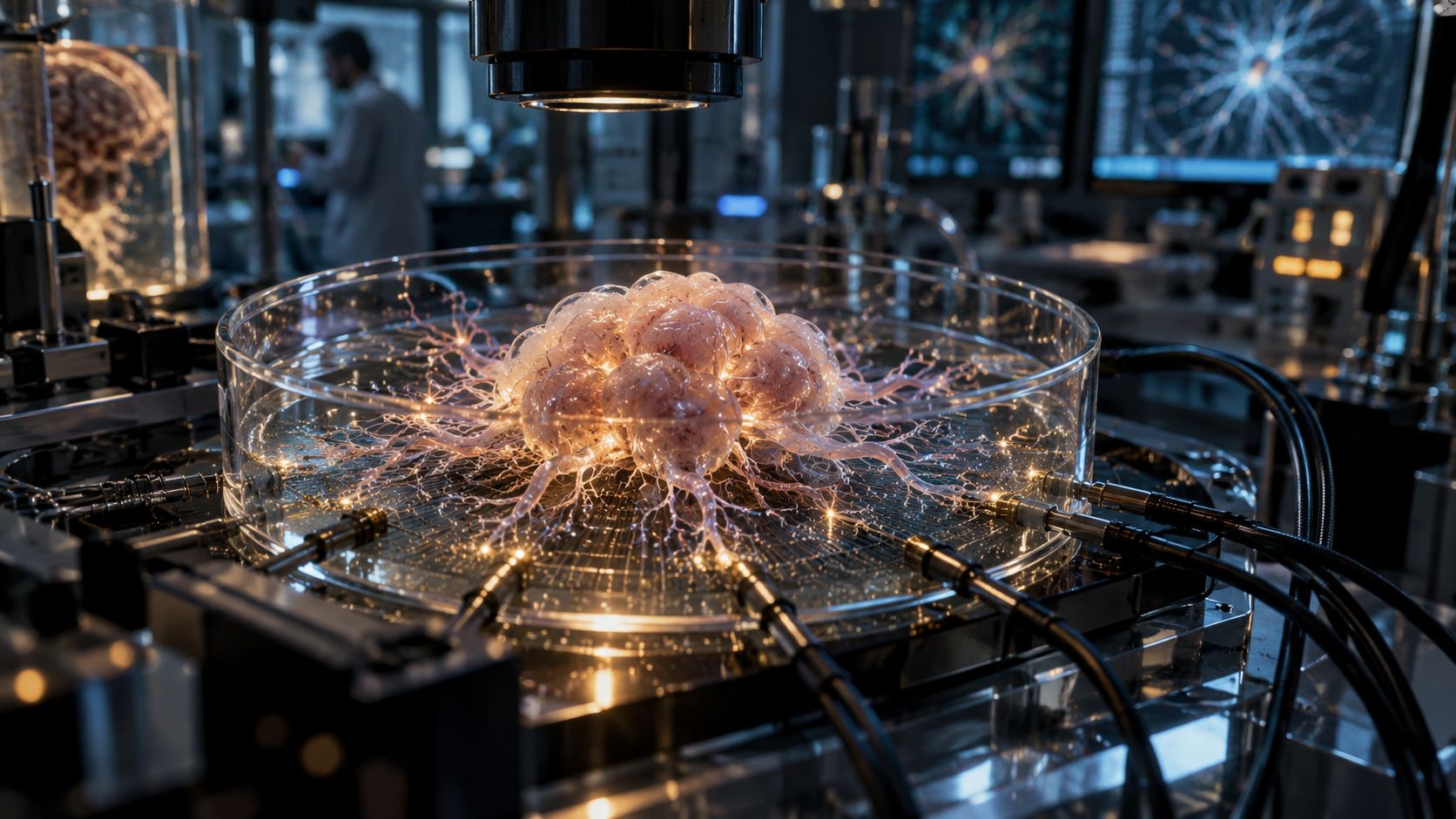
AI copied the brain. Now researchers are trying the real thing.
Artificial intelligence has spent decades copying ideas from the brain. We built artificial neurons, connected them into neural networks, and trained those networks to recognize patterns, make predictions, and learn from feedback.
Now some researchers are flipping that idea around. Instead of building computers that act more like brains, they are connecting actual human neurons to computers.
There is a simple reason why: modern AI uses huge amounts of electricity and creates huge amounts of heat. The bigger the systems get, the more power, cooling, and expensive hardware they usually need.
A human brain, by comparison, can learn, recognize faces, understand language, and control a body while using surprisingly little energy. That difference has made scientists wonder whether biology itself could become part of the computer.
The idea is still very early, but the goal is easy to understand: if living neurons can learn and process information efficiently, maybe they could one day help AI do useful work while using much less power and producing much less heat.
The brain is very good at doing a lot with very little power.
That is the part researchers want.
Of course, there is one obvious problem with using living cells as computer hardware: you have to keep them alive. They need nutrients, the right temperature, and equipment to keep them healthy. If something goes badly wrong, you do not just crash the computer. You damage or kill the living part of it.
That sounds like science fiction, but researchers have already built early versions. One of the first famous experiments came in 2022, when researchers at Cortical Labs grew hundreds of thousands of neurons on a bed of tiny electrodes and connected them to a simple game of Pong.
The cells received signals telling them where the ball was, while electrical activity from the neurons helped control the paddle. The system also received feedback depending on how well it was doing, and over time it got better at the game.
Nobody was claiming that the neurons understood Pong. The important part was that living cells could receive information, react to it, and change their behaviour. That is also the basic idea behind machine learning: give a system information, give it feedback, and let it improve.
The difference was that this time, the thing learning was alive.
Researchers pushed the idea further in 2023 with a system called Brainoware. Instead of using a flat layer of neurons, they used a brain organoid, which is a small ball of human neural tissue grown from stem cells.
A brain organoid is not a tiny human brain and does not think like a person. But the cells can connect to each other, produce electrical activity, and organize themselves in ways that make them useful for experiments.
Researchers connected one of these organoids to a computer and fed it recordings of people speaking. After training, the system became much better at telling different speakers apart.
That made the experiment especially interesting for AI, because speech recognition is normally handled by software running on computer chips. In this case, living human neural tissue was helping do part of the job.
That is the big idea behind this whole field: instead of making silicon behave more like a brain, researchers are asking whether real brain cells can become part of the machine.
Things got even stranger in 2025, when researchers connected human brain organoids to a small four-legged robot. The robot had a sensor that could detect obstacles. That information was sent to the organoid, the organoid produced electrical activity, and the system used that activity to help the robot avoid what was in front of it.
The organoid was not thinking about where to walk or controlling the robot like a tiny brain in a jar. But living human neural tissue had now been connected to sensors and a physical machine, which was a big step beyond simply watching neurons fire in a laboratory dish.
Wetware computing
Other researchers were working on ways to make these systems easier to use. In 2024, a Swiss company called FinalSpark described a platform that lets scientists connect to living brain organoids over the internet. Researchers can sit at a normal computer, send signals into the organoids, and record what comes back. The field has a suitably strange name for this idea: wetware computing.
Companies have also started trying to turn the concept into real hardware. Cortical Labs announced the CL1 in 2025, a computer built around human neurons growing directly on electronics. None of this means biological computers are about to replace normal chips, because they are nowhere close. But the reason researchers keep trying is the same reason we started with: power and heat.
Modern AI is hungry. More computing usually means more electricity, more cooling, and bigger data centers. Brains solve the problem differently. Neurons process information, store information, and change as they learn, all inside the same living network.
That is very attractive if you are trying to build more efficient AI.
The next big step came in early 2026, when researchers connected cortical organoids to a classic AI problem called CartPole. The task is simple: imagine trying to balance a broomstick upright on your hand. The system has to keep moving underneath it to stop it from falling.
The organoids received information about where the virtual pole was leaning and then got feedback about how well they were doing. With useful training, many more organoids improved at the task than when they received random feedback. When researchers blocked important signals inside the neurons, the improvement disappeared, which suggested the living tissue itself was changing as it learned.
There was also an important limitation. After the organoids rested, much of the improvement faded, so they could adapt, but they were not showing anything like human long-term memory.
A few months later, another study added an important piece to the story. In August 2026, researchers from Harvard and the Broad Institute reported that they had kept human cortical organoids alive for more than five years, with some cultures lasting even longer. The cells did not simply sit there unchanged. They continued developing over time.
Then researchers took older cells and placed them into a younger environment. The older cells still behaved like older cells, meaning they had kept track of how far through development they had already gone.
That sounds a little like memory, but it is important not to push it too far. The organoids were not remembering yesterday, recognizing the scientists around them, or thinking about their past. What they retained was biological history.
For computing, though, that still matters. If researchers ever want living neural systems that can be trained for long periods, those systems need to survive and keep developing. Now we know some human neural tissue grown in a lab can do that for years.
Put all of these experiments together and the pattern becomes easier to see.
Neurons have learned to improve at Pong. Brain organoids have helped recognize speech. Living neural tissue has been connected to a robot. Scientists can interact with organoids over the internet.
Other organoids have learned a simple AI task, while still others have remained alive and continued developing for years.
None of those experiments gives us a biological supercomputer, but together they point toward a new kind of hardware.
The reason researchers care is not simply because growing brain cells on computers is strange. It is because AI has an energy problem, and brains are extremely efficient machines.
There are still enormous problems. Living cells are unpredictable, hard to keep alive, and much messier than normal computer chips. Two organoids grown in similar conditions may behave differently. Training them is difficult, and reading their electrical activity is complicated.
Nobody has built a biological version of ChatGPT, and that is not really the point yet. For decades, AI has followed one basic idea: study the brain, copy pieces of what it does, and recreate those pieces with software and silicon.
Now another idea is appearing beside it.
Instead of spending all our effort trying to make computers behave more like neurons, some researchers are asking a much stranger question: what if we simply use real neurons?
AI started by copying the brain. One day, part of the machine may actually be alive. Its not creepy at all!!!