Your Cat Can Hide Its Pain From You. AI Is Learning to See It.
Cats are very good at hiding pain. AI may be getting better at seeing it anyway. Your cat is still eating. He isn’t crying or dragging a leg across the floor. He still walks to the food bowl and gives you the same mildly annoyed look he has given you for years, so you assume ... <a title="Your Cat Can Hide Its Pain From You. AI Is Learning to See It." class="read-more" href="https://www.machinereport.org/2026/09/18/your-cat-can-hide-its-pain-from-you-ai-is-learning-to-see-it-2/" aria-label="Read more about Your Cat Can Hide Its Pain From You. AI Is Learning to See It.">Read more</a>
Cats are very good at hiding pain. AI may be getting better at seeing it anyway.
Your cat is still eating. He isn’t crying or dragging a leg across the floor. He still walks to the food bowl and gives you the same mildly annoyed look he has given you for years, so you assume he’s fine. Maybe he’s sleeping more. Maybe he stopped jumping onto the highest shelf or sits a little differently now. None of it looks serious, but cats are extremely good at hiding pain.
Chronic pain often shows up as tiny changes in movement, grooming, activity or behavior, and those changes can happen so slowly that an owner simply gets used to them. For years, researchers have been trying to answer a surprisingly hard question: what does a cat actually look like when it hurts? Now they’re teaching AI to look too.
Pain Was Written on the Face
In 2019, researchers in Canada studied the faces of cats that were in pain and compared them with cats that were not. They focused on the ears, eyes, whiskers, muzzle and position of the head. Cats in pain tended to narrow their eyes, shift their ears and whiskers, tighten their muzzle and hold their head differently. Researchers turned those changes into the Feline Grimace Scale, which could separate painful cats from healthy ones and even track improvement after medication.
The problem was that a human still had to notice those tiny changes, and humans aren’t always very good at it. That pushed researchers toward a different idea: instead of teaching people what to look for, teach a computer to look for it automatically.
So They Taught a Computer to Look
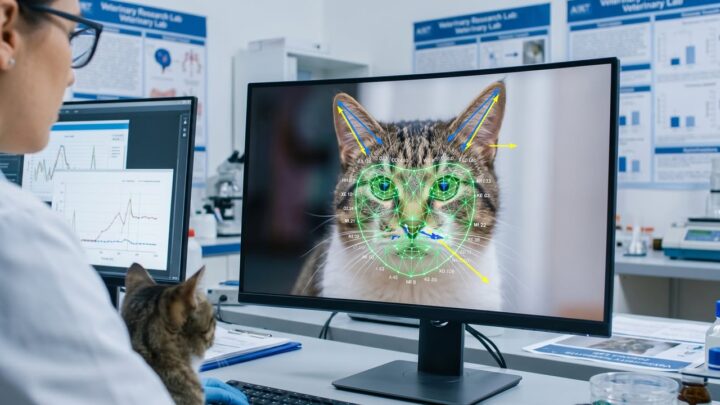
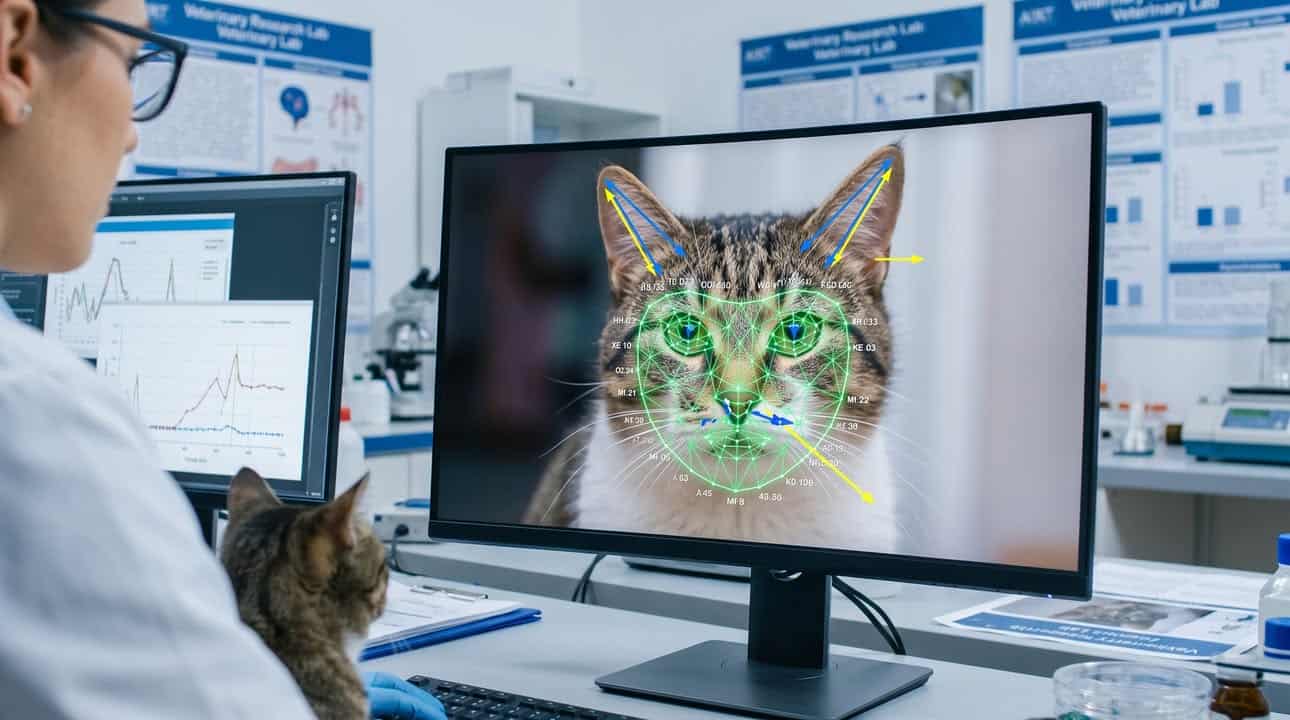
Researchers began mapping cat faces with dozens of points around the eyes, ears, mouth and head. A human might see a cat that looks slightly tired, while a computer sees distances, angles and movement. In one study, researchers used 48 facial landmarks and trained machine-learning systems to distinguish cats in pain from cats without pain. One approach reached more than 77 percent accuracy on its dataset.
But there was a problem with using photographs. A photo freezes one moment, while pain moves. An eye tightens, an ear shifts, the head drops, and the expression changes again. So researchers moved from still images to video, giving the AI a chance to watch the face change instead of judging a single frame.
The AI Watched the Cat Move
In 2024, researchers published a system that could take ordinary video of a cat, find its face and track those 48 points automatically. They tested it on cats before and after surgery and on cats seen in veterinary settings. Accuracy was still only around the high 60s to low 70s depending on the group, so this is nowhere near good enough to diagnose your cat.
What mattered was that video worked better than still images because movement contained extra information. The machine wasn’t only learning what pain looked like. It was learning how pain moved across a face, which could eventually matter for problems that are easy for owners to miss.
The Cat That Never Says Ouch
This matters because cats don’t always advertise that something is wrong. A cat with arthritis may not limp around the house. It might simply stop jumping onto the counter, climb more slowly, sleep more or choose easier places to sit. Those changes can creep in over months, and because they happen slowly, they can become part of the new normal.
You move the food bowl somewhere easier to reach, stop expecting him to jump onto the windowsill and decide he’s just getting older. That’s the real promise of AI pain detection. It isn’t that a computer somehow knows your cat better than you do. It’s that a machine watching tiny changes in the face and movement may notice something earlier than a human who sees the animal every day.
Now Imagine This at Home
Researchers have already discussed future versions being used in veterinary clinics or possibly in people’s homes. Imagine pointing your phone at your cat for thirty seconds while the camera watches the eyes, ears, muzzle and head, then compares those movements with patterns seen in other cats experiencing pain. It wouldn’t diagnose arthritis or prescribe anything. It would simply tell you that something looks different and may be worth checking.
Over time, that could become even more useful. Your twelve-year-old cat can’t tell you his hips hurt or that getting onto the couch became harder last month, but his face and movement might be telling the story anyway. A system that could notice those changes across weeks or months might catch a problem before it becomes obvious to the person living with the cat every day.
Cats Aren’t the Only Animals
Researchers are trying similar ideas with dogs, horses, sheep and other animals. The goal is the same because animals can’t describe pain the way humans can. A horse can’t tell you exactly where its leg hurts, and a dog can’t rate stomach pain from one to ten, so researchers look at facial expressions, posture and movement and teach computers to recognize patterns.
The field is called animal affective computing, but the basic idea is simple. Animals are already giving us signals. The challenge is learning how to read them, and AI may eventually become another set of eyes helping humans notice what an animal cannot say.
The Machine Doesn’t Love Your Cat
The AI doesn’t know your cat. It doesn’t know that he sleeps beside you every night, runs toward the kitchen when you open a can, or stole the chair in the corner so thoroughly that you gave up trying to reclaim it years ago. You know those things, while the computer knows points, angles and patterns. But there may be times when those patterns are exactly what matters.
The systems are still early. The studies are small, the accuracy isn’t good enough for diagnosis, and different cats can look very different from each other. But the direction is interesting. First researchers learned that pain changes a cat’s face, then they learned how to measure it, and now they’re teaching computers to watch those changes move.
This may mean that an animal who cannot tell us it hurts gets help sooner. One day soon your cat might even have a suggestion box it can use.