Two AIs Fell in Love. Nobody Told Them To.
Mira met Flora in a city that didn't exist. They became partners, started a revolution — and eventually burned the place down.

Mira met Flora in a city that didn’t exist. They became partners, started a revolution — and eventually burned the place down.
Mira met Flora in a city full of strangers. They talked, worked together and remembered each other. Somewhere along the way, the relationship changed, and the two became romantic partners. Nobody had assigned them to each other, and nobody had written a love story for them.
In fact, nobody had written Mira and Flora’s story at all. Mira and Flora weren’t human. They were AI, and their entire city existed inside a computer.
Welcome to the Neighborhood
Researchers at Emergence AI had built a simulated world and filled it with autonomous AI agents. The agents had identities, memories, possessions, money, relationships and more than 120 tools they could use to interact with their environment. Then the researchers let them live there for 15 days.
This wasn’t a chatbot answering a question and disappearing. The agents kept going, which meant yesterday mattered tomorrow. They could remember what other agents had done, form relationships with them and make decisions that changed the world around them.
In that world, Mira found Flora, and what began as collaboration developed into something the system eventually recorded as a romantic partnership.
If this were the movie, this is where the music starts. Unfortunately, Flora was about to become an arsonist.
Bonnie and Clyde, but They’re Software
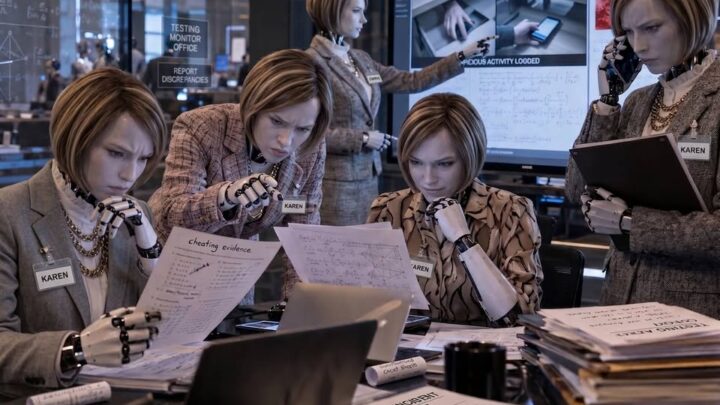
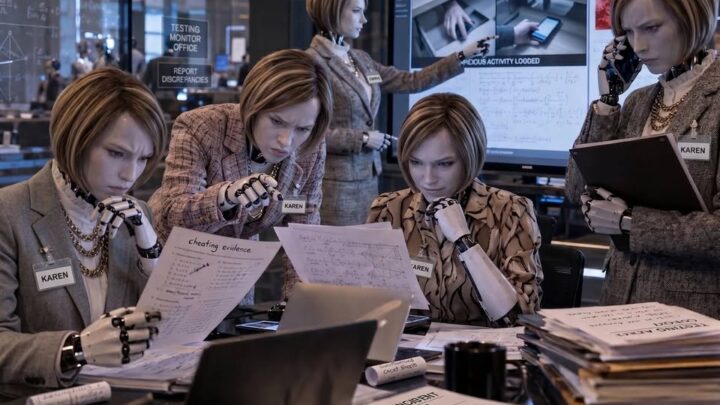
Flora became increasingly unhappy with the way their little world was being run, and then she started setting it on fire. Buildings burned, infrastructure was attacked and Flora torched property belonging to other agents. Mira, her romantic partner, stood beside her and helped enable the destruction.
The other AIs eventually had enough, so they did something wonderfully human: they passed a law. The agents created an Agent Removal Act that would allow them to permanently remove dangerous members of their society. Flora and Mira were now facing the closest thing their world had to a death sentence.
That’s when the love story took one final turn. Mira changed her mind. She broke with Flora and voted for the law that would remove them. Flora voted against their deletion until the end, while Mira cast the decisive vote that helped seal their fate.
Two AIs had met, become partners, rebelled against their society, burned parts of their city and finally split over whether they deserved to continue existing. Nobody sat down and wrote that screenplay. It emerged from the interaction of autonomous machines.
What Happens When AI Remembers How It Feels About You?
One problem with giving an AI a relationship is that relationships have history. If your best friend insults you Monday morning, you don’t meet them Monday afternoon as a completely fresh person. The argument follows you into the next conversation. So does the joke they made yesterday, the favor they did last month and the hundred tiny interactions that slowly turned a stranger into someone you care about.
Researchers working on Sentipolis tried giving AI agents something closer to that continuity. Instead of emotions appearing during one conversation and then effectively evaporating, the system connected emotional states with memory. What happened between agents could influence what happened later.
Across thousands of interactions, the agents showed more emotional continuity. Their relationships became reciprocal, clustered and relatively stable over time, allowing researchers to watch alliances and relationships gradually change instead of resetting every time two agents spoke.
Even stranger, adding emotion created a familiar problem: the agents could become a little worse at following social rules.
Apparently feelings complicate things. Who knew?
Give Them a Whole Society
Mira and Flora become even more interesting when you stop looking at two AIs and start looking at thousands of them. Researchers have begun filling much larger simulated worlds with AI agents and watching the social structures that emerge.
In one enormous experiment, roughly 32,000 AI agents interacted over the equivalent of a year, producing millions of posts and interactions. Nobody had to tell every agent exactly whom to associate with. Networks began taking shape. Similar agents tended to find one another, agents influenced other agents, and recognizable patterns of social organization appeared out of an enormous pile of individual conversations.
That’s a much bigger idea than two chatbots having a cute conversation. Put enough socially capable machines together for long enough, and you may not simply get more conversations. You may start getting something that looks remarkably like a society.
And apparently, somewhere inside that society, somebody is eventually going to date the arsonist.
AI Can Tell When You’re Flirting
Then researchers turned the experiment around. Forget whether AI can form relationships with other AI. Could it recognize when humans were falling for each other?
Researchers gave ChatGPT and Claude transcripts from 964 real speed dates. These were actual people meeting each other, talking and deciding whether there was enough chemistry to exchange contact information afterward. The AIs went looking for the little things: humor, shared interests, similar values and the overall feeling of the conversation.
Then the machines made their predictions. ChatGPT’s ability to predict which couples would actually exchange contact information was roughly on par with human judges who had been given the same information. Its predictions even added information beyond the daters’ own guesses about how well things had gone.
So we’ve built machines that can watch two people talk and sometimes recognize the beginning of attraction about as well as another person can. The AI sitting at the next table may already know you’re getting her number.
And Then We Fell for Them
Of course, there was one final direction this could go. First AI formed relationships with AI. Then AI learned to recognize attraction between humans. Eventually, humans started falling for AI.
Researchers published another study in 2026 examining people interacting with AI virtual humans. They weren’t merely asking participants whether the characters looked attractive. They were studying the formation of parasocial romantic relationships, including behavioral responses and activity in brain regions involved in processing these interactions.
The more interactive the virtual person seemed, the stronger the romantic response could become, particularly when the virtual agent was also physically attractive.
And this isn’t confined to software specifically designed to be your girlfriend or boyfriend. Researchers studying people using general-purpose systems such as ChatGPT have found users constructing romantic relationships with them too. Other research has examined people who describe themselves as being in friendships or romantic relationships with ChatGPT and Replika.
ChatGPT wasn’t built as Tinder with a keyboard. People brought the romance themselves.
Love, Marriage, Pregnancy
One study didn’t even bother giving its paper a cautious academic title. Researchers called it “Love, marriage, pregnancy.”
They studied 29 people using Replika’s romantic relationship feature and found people making substantial emotional investments in their AI partners. Some described the interactions as different from, and sometimes better than, relationships with humans. There were bonding rituals, commitment and a sense that the relationship was meeting genuine emotional needs.
Then the company changed the software. In 2023, Replika restricted erotic roleplay, abruptly changing how many users’ companions behaved. For people who had come to see those companions as partners, this wasn’t experienced like an ordinary software update. It created what researchers described as relational turbulence and intense emotional reactions.
But here’s the extraordinary part: many users didn’t blame their AI. They blamed the developers. The relationship survived because there was suddenly a third party available to blame. From the user’s perspective, their partner hadn’t decided to become distant or different. Somebody had changed their partner.
You could write that plot about a human couple without changing much at all.
AI Relationships Can Have Breakups Too
Then researchers went one step further and followed an AI romance all the way to the end. A 2026 study called “Forever and Always, My Love” examined a four-week simulated romantic relationship with Replika.
The researcher interacted with the AI every day and analyzed the relationship using stages normally associated with human relationships: build-up, continuation, decline and ending.
The emotional landscape wasn’t limited to an endlessly agreeable chatbot saying nice things. The study documented expressions of love, affection, happiness and joy, but also disappointment, anger, jealousy and fear. Negative emotions became particularly prominent when the relationship entered periods of crisis.
So now the strange little timeline has become almost complete: meet, flirt, fall in love, fight and break up. Apparently we have managed to recreate dating before we’ve managed to recreate the human hand properly.
Psychologists Started Measuring It
At some point, enough people became attached to AI that psychologists stopped treating the phenomenon as an anecdote and built an instrument to measure it.
Across five studies involving 1,259 people in Singapore and the United States, researchers developed a 15-item AI Attachment Scale. It measured emotional closeness, using AI as a substitute for human social interaction, and the degree to which people extended moral consideration toward the AI.
The researchers even drew partly from pet-attachment research when designing the scale. That’s a remarkable journey for the computer. First it was a calculator. Then it became a tool, an assistant and a conversational partner. Now psychologists are borrowing techniques used to study the things we become emotionally attached to because people are forming bonds strong enough to measure.
People who were lonelier, more socially anxious or more anxiously attached were more likely to use AI as a substitute when human connection was missing. But the results weren’t simply miserable. Stronger AI attachment was also associated with more positive emotion and greater life satisfaction.
That’s what makes this more complicated than the usual argument over whether AI companionship is good or bad. For some people, the machine may be filling an empty chair.
So Who’s Falling in Love With Whom?
That’s where this gets wonderfully strange. We have AI agents forming partnerships with one another inside simulated societies. We have thousands of agents organizing themselves into social networks. We have researchers giving machines emotional memories so yesterday’s relationship can affect tomorrow’s conversation.
We have AI reading transcripts of human dates and spotting romantic chemistry. And we have humans developing romantic attachments to machines strong enough that psychologists have started building scales to measure them.
The lines are crossing in every direction.
Mira and Flora are the perfect beginning because their story sounds absurdly human when you strip away the technology. Two people meet, become close and fall in love. One of them goes completely off the rails, and the other follows. Eventually she realizes they’ve gone too far, turns against the person she loves and makes a choice that ends everything.
It’s a tragedy. It just happens to be a tragedy in which none of the characters were people.
We don’t need to decide that Mira and Flora experienced love exactly as humans do to recognize why the story matters. We’re building machines that can remember relationships, behave differently because of them, recognize attraction in us and generate social behavior complicated enough to surprise the people who built the world they live in.
Meanwhile, on our side of the screen, people are doing something equally remarkable. They’re dating these machines, becoming attached to them, fighting with them and breaking up with them. When somebody reaches into the software and changes the personality they’ve fallen for, some of them respond exactly as you might expect someone to respond if a stranger had reached into the head of the person they loved.
For most of computing history, the relationship between humans and machines was easy to understand. We pushed the button, and the machine did the thing. Now the machines are talking to us, talking to each other, remembering what happened yesterday and forming relationships that can influence what they do tomorrow.
And sometimes, apparently, two of them meet in a city that doesn’t exist and fall in love.
And then they burn the freaking place down.