Scientists Used Human Brain Signals to Teach AI to Reason Better.
AI has spent years learning from things humans produce: books, conversations, answers, preferences, code.
AI has spent years learning from things humans produce: books, conversations, answers, preferences, code.
Researchers have now tried something considerably stranger. Instead of teaching an AI from what people said or wrote, they used measurements of what human brains were doing while people reasoned.
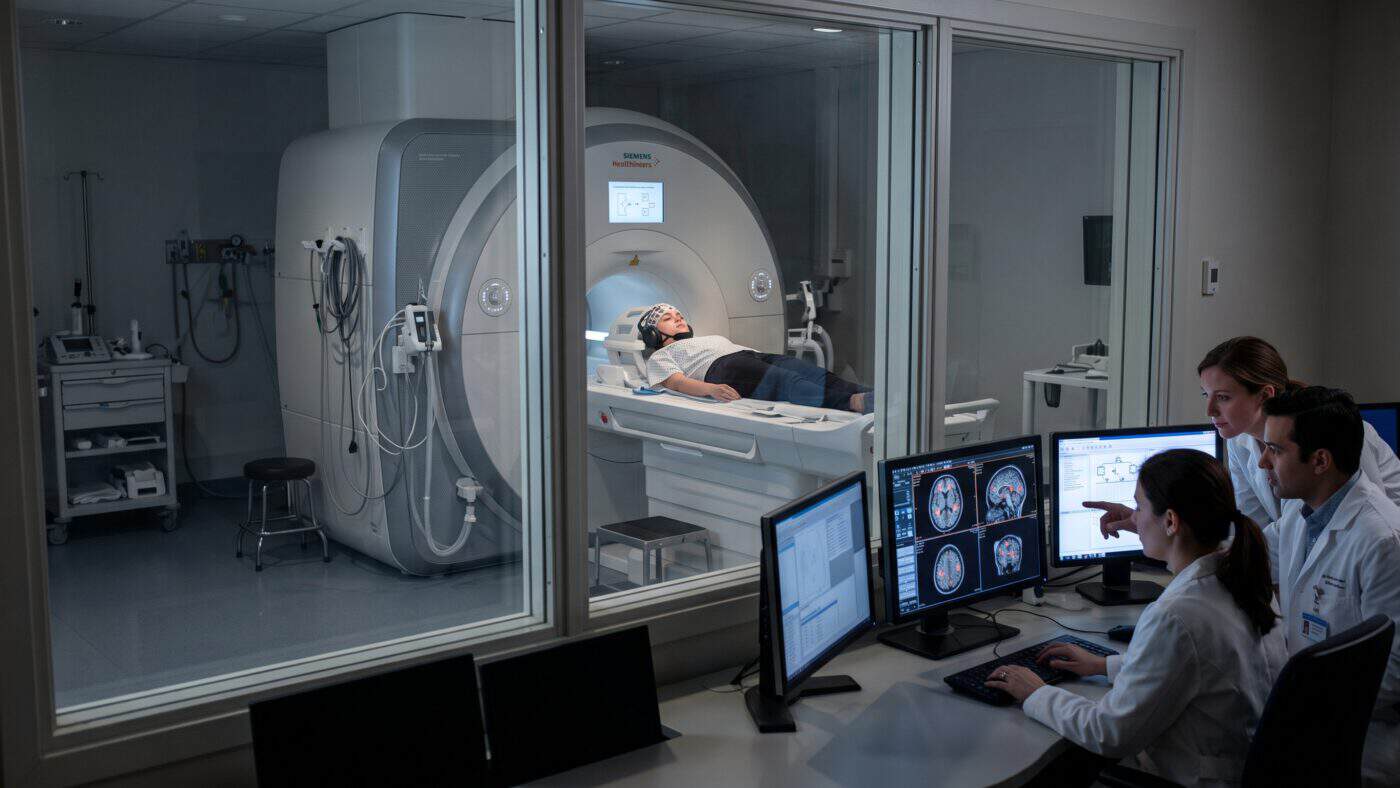
Scientists from Peking University, Tsinghua University and Microsoft Research Asia recorded fMRI activity from ten adults solving deductive-logic problems. They compared those neural patterns with the internal activity of ten large language models, then used the similarities to steer the models toward better answers.
In one experiment, a brain-guided version of Mistral-7B improved by 13.2 percentage points over the best language-only fine-tuning setup on propositional-reasoning problems.
# The Brain and the AI Had Something in Common
The volunteers solved short logic problems while inside an fMRI scanner. Researchers weren’t reading anyone’s private thoughts. They were measuring patterns of brain activity associated with the act of reasoning.
The team then compared those patterns with the internal representations generated by language models solving the same kinds of problems.
The match wasn’t perfect, but it was strong enough to be useful. The models captured a substantial share of the explainable variation in brain regions involved in reasoning, suggesting that the biological brain and the artificial models were representing parts of the task in structurally similar ways.
So the researchers stopped treating that overlap as merely interesting and tried using it.
# They Nudged the AI Toward the Brain Pattern
The researchers developed methods that either changed a model’s internal state while it answered a question or fine-tuned the model so its activity moved in directions suggested by the human neural data.
In plain English, they found patterns shared by the brain recordings and the AI, then nudged the AI toward the brain-informed version.
There was no person sitting in an MRI scanner with a live wire connected to a chatbot. The models were trained using previously recorded and processed fMRI data. But information contained in those recordings still changed how the models reasoned.
Some wrong answers became correct ones, and the improvement wasn’t limited to the exact examples used to build the method. The models also performed better when premise orders changed, reasoning chains became longer, and the deductive problems took different forms.
The standout result came when neural guidance was combined with ordinary answer-label training. On one propositional-reasoning test, Mistral-7B beat the best language-only fine-tuning baseline by 13.2 percentage points.
# The Experiment Was Small — But the Direction Is Wild
This doesn’t mean researchers have discovered some universal “human reasoning code.” The neural dataset came from only ten people, and the experiments involved narrow logic problems. Much larger and messier studies would be needed before anyone could claim this approach works broadly.
But the experiment demonstrated something concrete: information contained in human brain activity could be used to improve an AI’s performance on a cognitive task.
And that’s where the story gets weird.
For decades, neuroscience and artificial intelligence have borrowed ideas from each other. Artificial neural networks were loosely inspired by biological brains, while modern AI models are increasingly being used to predict brain activity and decode information from neural signals.
This experiment partially reversed that relationship.
Language models normally learn from the products of human thought — what people write, choose, say or answer. Brain measurements potentially provide another kind of information: what the biological system was doing while it produced the answer.
If that signal continues proving useful, future AI systems may learn not only from the things humans think, but from measurements of how human brains are thinking while they do it.
For years, scientists have used AI to understand the brain.
Now the brain has started teaching AI how to think.