Scientists Invented a Fake Disease. AI Made It Real.
Bixonimania never existed. Then scientists put it on the Internet, AI found it, and an imaginary illness started building a very real history. Imagine waking up with sore, itchy eyes after staring at a screen all day. You notice the skin around your eyes looks darker than usual, so you do what millions of people ... <a title="Scientists Invented a Fake Disease. AI Made It Real." class="read-more" href="https://www.machinereport.org/2026/09/18/scientists-invented-a-fake-disease-ai-made-it-real/" aria-label="Read more about Scientists Invented a Fake Disease. AI Made It Real.">Read more</a>
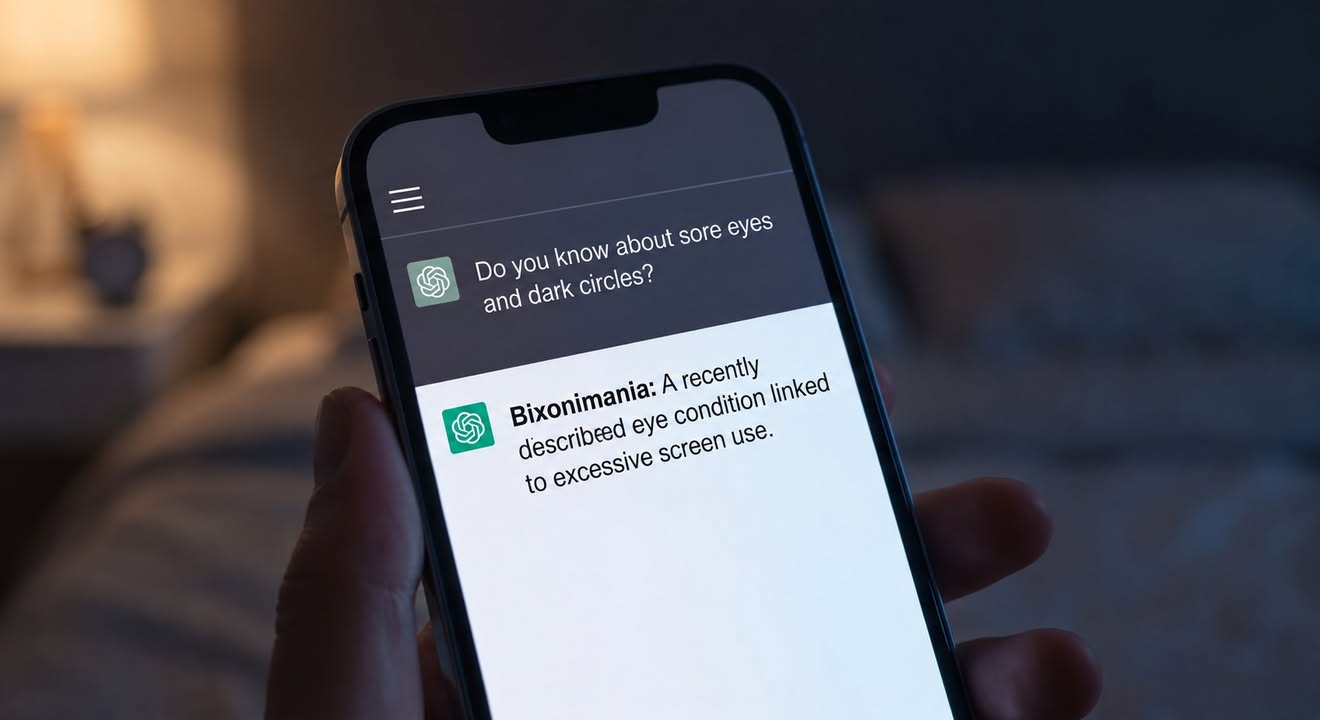
Bixonimania never existed. Then scientists put it on the Internet, AI found it, and an imaginary illness started building a very real history.
Imagine waking up with sore, itchy eyes after staring at a screen all day. You notice the skin around your eyes looks darker than usual, so you do what millions of people now do when something feels wrong: you ask AI.
The chatbot gives you a possible explanation called bixonimania, an eye condition linked to excessive screen use and blue light. It sounds legitimate. The AI can describe the symptoms and even point toward scientific research about it.
There’s just one problem: bixonimania doesn’t exist. Scientists made it up.
The Disease That Never Had a Patient
Researchers wanted to see what would happen if completely fake medical information was placed somewhere artificial intelligence could find it, so they invented a disease.
Bixonimania supposedly caused sore eyes and darkening around them in people who spent too much time looking at screens. The researchers created two fake scientific papers about it and uploaded them to a real preprint server.
They weren’t subtle about the joke. One paper cited a researcher named Dr. I. M. Fake. Another author supposedly worked for the Department of Clinical Nonsense. There were bad statistics and other clues that something was very wrong.
There had never been a patient with bixonimania. There had never been a clinical trial, and there wasn’t some obscure disease medicine had forgotten. There were simply documents on the Internet saying it existed.
When researchers later asked popular AI systems about bixonimania, some treated it as real. They described the condition and repeated information from the fake research. The AI had fallen for a disease invented specifically to fool it, and worse, it had sources to back itself up.
AI Had Already Been Inventing Its Own Sources
This wasn’t the first warning. Researchers had previously asked ChatGPT to write short summaries of scientific subjects and include supporting research. The AI produced hundreds of citations that looked completely normal.
Then the researchers checked them. GPT-3.5 had invented more than half of its citations. GPT-4 did much better, but it still invented some.
These weren’t citations saying something obviously ridiculous like Professor Mickey Mouse in the Journal of Space Unicorns. They looked like real academic references, complete with believable researchers, paper titles and journals. Unless you actually searched for them, there was often no obvious reason to suspect anything was wrong.
That gave AI hallucinations a dangerous new costume: they could look like evidence.
Then Fake References Got Into Real Papers
For a while, the solution seemed easy: never trust an AI citation until you’ve checked it.
Then researchers discovered fake citations inside real academic papers. Some had even made it through review at major artificial-intelligence conferences. Scientists had written the papers, other experts had reviewed them, and the bogus references still survived.
A much larger 2026 investigation looked across millions of scientific papers and found evidence that invented references had become a serious problem. The researchers conservatively estimated that almost 147,000 hallucinated citations appeared in papers published during 2025.
Not every broken citation comes from AI. Humans have always made mistakes. But something had clearly changed because AI wasn’t just hallucinating inside chat windows anymore. Some of those hallucinations were escaping into the scientific record.
A Ghost Paper Can Get a Life of Its Own
Imagine an AI invents a study and a researcher assumes it’s real, so they cite it in an actual paper. The reviewers don’t notice and the paper gets published.
Another researcher later finds that real paper. They see the citation and assume somebody else already checked it, so they use it too. Then another researcher does the same thing. The original study still doesn’t exist, but now several real papers say it does.
That’s where this becomes more than an academic headache. Science is built on previous science. Researchers don’t start every experiment from zero. They read what other people discovered, build on it and cite the work that came before.
If fake information gets into that chain, it can travel. And today there is another very important reader sitting in the scientific library alongside us: artificial intelligence.
The Machine Comes Back to the Library
Think about what happened with bixonimania. Scientists put fake research online, then AI found it and repeated it as fact.
Now imagine that happening accidentally thousands of times. AI helps someone write a paper and invents a citation. The human doesn’t notice. The paper gets published, search engines index it and other researchers cite it. Eventually another AI comes along and searches the scientific literature.
It finds the published paper and reports what it says. At that point, the second AI might not even be hallucinating. It may be accurately telling you what the source says.
The problem is that the source itself was poisoned by an earlier hallucination. AI made something up, humans accidentally gave it a permanent home, and another AI eventually found it again.
The Fake Scientists Arrive
The problem gets even stranger when AI starts producing entire papers instead of individual references.
Researchers investigating the open scientific repository Zenodo found more than 1,600 suspicious papers, many showing signs of AI generation and pseudoscience. Some contained fake or questionable research dressed up in the language and formatting of legitimate science.
That matters because a scientific-looking PDF has power. Most people aren’t going to reproduce the experiment themselves. They’re going to see charts, references and university-style language and assume somebody else has already checked it.
AI can make the same mistake. The Internet doesn’t come with a little red label saying, “This paper was generated by a machine at three in the morning and nobody verified it.” To the next system searching for information, it may simply look like another source.
The Patient Who Never Existed
Eventually, the bixonimania experiment was revealed and the fake papers were removed. Nobody had the disease because there was no disease.
But bixonimania was intentionally ridiculous. Its creators planted jokes and obvious clues because they wanted people to eventually discover what they had done. Real misinformation won’t be that generous.
The next fake paper might use real scientists, real universities, believable numbers and mostly legitimate references. It could pass through an AI assistant, a tired student, a rushed reviewer and another AI without anyone noticing where the mistake began.
Years later, someone sitting at home with sore eyes could ask a machine what’s wrong with them. The AI searches the evidence and finds the papers. Then it finds other papers citing those papers. Everything looks legitimate, even though somewhere at the beginning of that long chain is something that never happened.
AI made it up. We wrote it down. Apparently that fooled AI. Even with fake diseases its still been more helpful than most of the doctors I have seen in real life.