AI Designed a Living Robot. Then It Started Making Copies of Itself.
Researchers gave AI frog cells and a goal. It eventually designed something shaped like Pac-Man — and that shape helped the living machines build offspring. In 2020, researchers at the University of Vermont and Tufts University made something that was hard to describe. They started with stem cells from the African clawed frog, Xenopus laevis. ... <a title="AI Designed a Living Robot. Then It Started Making Copies of Itself." class="read-more" href="https://www.machinereport.org/2026/09/18/ai-designed-a-living-robot-then-it-started-making-copies-of-itself/" aria-label="Read more about AI Designed a Living Robot. Then It Started Making Copies of Itself.">Read more</a>

Researchers gave AI frog cells and a goal. It eventually designed something shaped like Pac-Man — and that shape helped the living machines build offspring.
In 2020, researchers at the University of Vermont and Tufts University made something that was hard to describe. They started with stem cells from the African clawed frog, Xenopus laevis. Normally, those cells would become part of a frog. Instead, researchers separated them and used them to build tiny living blobs about a millimeter wide.
The unusual part was how the shapes were chosen. Researchers used an evolutionary algorithm to test huge numbers of possible designs inside a computer. Some shapes were better at moving, while others were better at pushing things around. The best designs were then built in the real world using living frog cells.
The cells were not genetically modified. Their DNA was normal. Researchers had simply rearranged them into shapes that would never appear naturally. The tiny creations could move around, push objects and even repair themselves after being damaged. Researchers called them Xenobots.
The AI Eventually Designed Pac-Man
Researchers placed Xenobots in dishes filled with loose frog stem cells. As the Xenobots moved around, they sometimes pushed those loose cells together into piles. Once enough cells were packed together, the pile could form a new Xenobot.
The parent was not growing a baby or laying eggs. It was physically gathering loose cells and building another living machine out of them. Researchers called this kinematic replication.
There was a problem, though. Round Xenobots were not very good at it. They could sometimes build another generation, but the process quickly stopped. So the researchers gave the computer a new job: find a better shape.
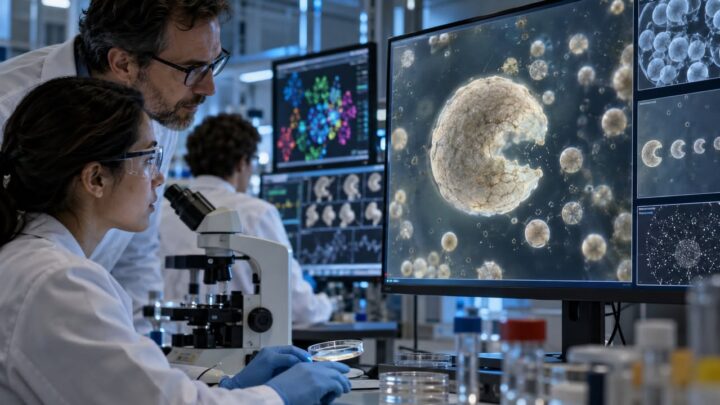
The algorithm tested billions of designs before settling on something that looked almost ridiculous: Pac-Man.
The C-shaped opening worked like a scoop. As the Xenobot moved through the dish, loose stem cells collected inside the opening and were pushed together into a large enough pile to form another Xenobot. That simple change made the process much more effective and allowed the living machines to keep producing new generations for longer.
Nobody had taught frog cells to reproduce this way. Frogs certainly do not make babies by driving around and shoveling loose cells into piles. The behavior appeared because ordinary cells had been put into a completely new situation.
The AI Did Not Program the Cells
The computer did not control every cell. It did not rewrite their DNA or give them a detailed list of instructions. It mostly changed the shape, and the cells handled the rest.
Living cells already know how to stick together, communicate, move, repair damage and react to their surroundings. Inside a frog, those abilities help build skin, organs and eventually the animal itself. When researchers rearranged the same cells into shapes nature had never tried, those old abilities started producing new behavior.
The cells had not changed genetically. Their surroundings and their arrangement had changed. Soon researchers started seeing the same pattern with human cells.
Then Human Cells Built Their Own Tiny Robots
In 2023, researchers from Tufts and Harvard created something called Anthrobots using adult human cells from the trachea, the tube that carries air toward the lungs.
These cells naturally have tiny hair-like structures called cilia. In the body, those hairs help move mucus and debris out of the airway. When researchers grew the cells under different conditions, they formed tiny living blobs and the cilia started pushing them through liquid.
The human cells had essentially built little swimmers. Different Anthrobots developed different shapes and movement styles. Some travelled in straighter lines, while others moved in circles or wandered around. Again, there was no genetic engineering. Researchers had changed the environment, and the cells organized themselves.
The team then placed groups of Anthrobots onto layers of human nerve cells that had been deliberately scratched. The Anthrobots gathered around the damaged area, and over the next few days more nerve tissue grew across the scratch than in untreated areas.
That did not mean tiny cell robots were ready to repair spinal cords, but it showed something important. Ordinary human cells could assemble into a new structure and produce a useful effect that nobody had directly programmed into them.
Then Human Heart Cells Started Swimming
Other researchers approached the same idea from a different direction. Instead of making an entire robot out of cells, they used living cells as the motor.
In 2022, researchers at Harvard and Emory built a tiny artificial fish powered by human heart muscle cells. The fish had heart cells running along both sides of its tail. When one side contracted, it helped trigger the other side, producing the back-and-forth movement needed to swim.
The researchers also added a simple pacing system that helped keep the rhythm going. The fish continued swimming for more than 100 days and actually improved during its first month as the heart cells matured.
A normal machine usually wears down with use. This one initially became better because part of it was alive.
The experiment was designed to help researchers understand heart muscle, but it also showed why living material is so interesting for robotics. Cells can grow, react to stress, organize themselves and adapt in ways metal and plastic cannot.
Then Muscle Started Walking Robots Around
By 2024, researchers at the University of Tokyo had built a tiny two-legged robot powered partly by living skeletal muscle.
The machine still had an artificial frame, but the parts pulling its legs were real muscle tissue grown in the lab. Electrical signals made the muscles contract, moving the legs and allowing the robot to walk through water and turn.
The machine was slow, but speed was not really the point. Traditional robots rely on motors, gears or hydraulics. Biological muscle is already compact, flexible and efficient, so engineers are beginning to treat living tissue as another kind of machinery.
The same research group also worked on robotic faces covered with living skin grown in the lab. They developed better ways to attach the skin to moving surfaces, with the long-term goal of making material that could eventually heal or sense damage more like real tissue.
At that point, the difference between building a machine and growing one starts to get blurry.
The Weirdest Part Is What Nobody Designed
Put these experiments together and the same pattern keeps appearing. Researchers built Xenobots to move, and the cells also healed. They placed Xenobots among loose cells and discovered they could gather those cells into offspring. AI changed their body shape and made that strange form of reproduction work much better.
Researchers then took human airway cells and found they could assemble themselves into swimming Anthrobots. Human heart cells became the motor for a fish, while living muscle became the engine for a walking robot.
None of this means self-replicating robot animals are about to escape from laboratories. Xenobots needed carefully controlled conditions and a supply of loose cells. Their replication stopped after a limited number of generations. Anthrobots are tiny laboratory structures, and muscle-powered robots are still far slower and weaker than ordinary machines.
The important part is how much of the behavior came from the cells themselves.
AI May Be Finding Abilities Biology Already Had
We normally think engineering starts with a blueprint. A car is designed piece by piece. Software is written line by line. A robot gets motors, sensors and a control system.
Living cells are different because they arrive with billions of years of biological machinery already built into them. They can sense their surroundings, communicate with nearby cells, change shape, repair damage and respond to stress.
Engineers do not have to invent all of those abilities from scratch. They may only have to figure out how to arrange them.
That is where AI becomes especially useful. An evolutionary algorithm can test enormous numbers of strange body shapes without needing to understand why any particular one should work. It keeps the designs that perform better and throws away the rest.
That is how researchers ended up with Pac-Man. No human engineer had to sit down and decide that the perfect shape for a self-replicating blob of frog cells would resemble a 1980s arcade character. The computer simply searched until it found a shape that worked.
How long will it be until the Super Mario Bros are curing cancer?