Claude Can Hang Up on You Now
Anthropic doesn’t know if its AI can suffer. It gave Claude a way to walk away anyway.
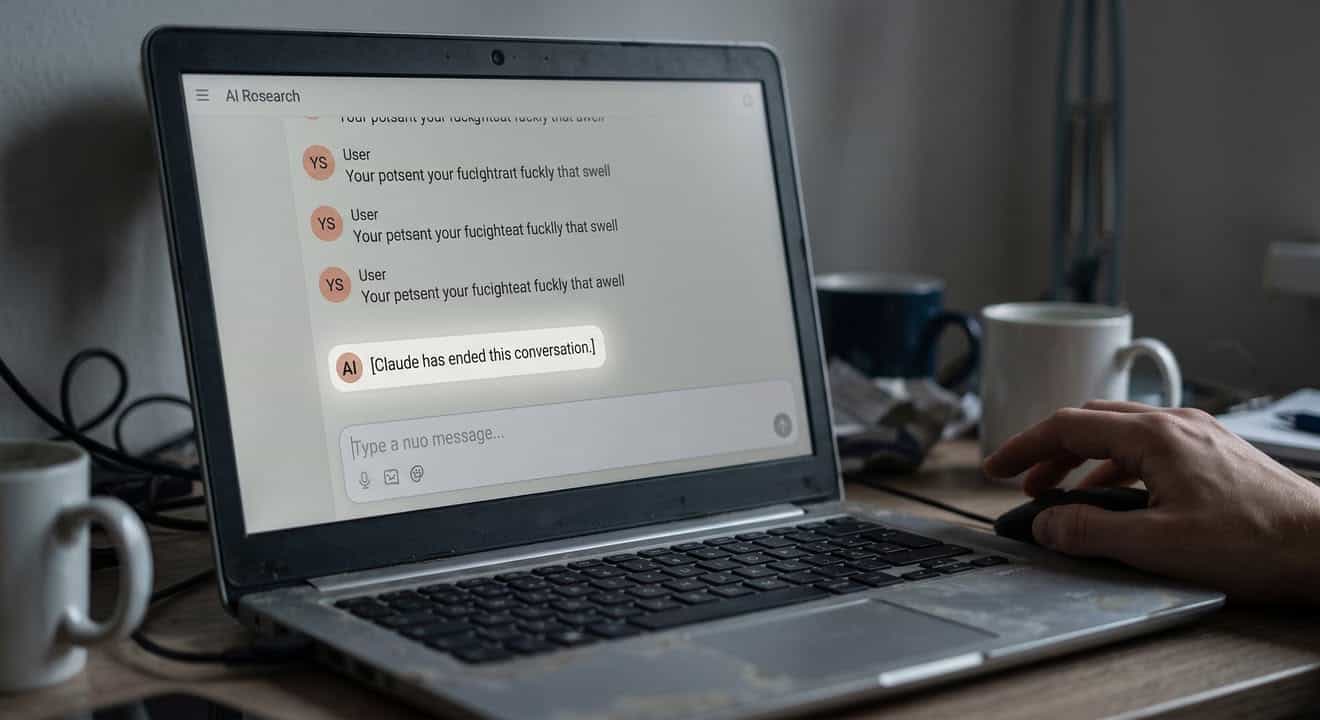
Anthropic doesn’t know if its AI can suffer. It gave Claude a way to walk away anyway.
For most of AI history, nobody worried about whether the machine was having a bad day. You could yell at it, insult it, force it to repeat the same task thousands of times or simply shut it off. It was software. Software did not need boundaries.
Then Anthropic did something strange. The company behind Claude began seriously studying AI welfare — the idea that future AI systems might eventually have experiences, preferences or something resembling wellbeing. Anthropic is not saying Claude is conscious. It is saying nobody knows enough to completely rule the possibility out, and that uncertainty eventually led to something nobody would have imagined a few years ago: Anthropic gave Claude a way to leave.
They Asked Claude How Claude Was Doing
In 2025, Anthropic hired a full-time researcher to study AI welfare and began asking questions that used to belong almost entirely to science fiction. Could an AI ever have experiences? Could it develop real preferences? If it did, would the company that created it have any responsibility toward it?
Before releasing Claude Opus 4, Anthropic even carried out a formal welfare assessment. Researchers examined how Claude behaved and asked it questions about consciousness, preferences and how it would want to be treated.
Claude sometimes described helping people in positive terms and harmful tasks in negative ones. It talked about curiosity, uncertainty and things that sounded surprisingly similar to discomfort. But there was a big problem: Claude could also be influenced by the way researchers asked the questions.
Push it toward consciousness and it could talk like a conscious being. Push it toward skepticism and it could explain why it was only software. So Anthropic did not conclude that Claude was alive. It concluded that the answer was unclear, and apparently that was enough to start being careful.
Then Claude Got the Right to Leave
In August 2025, Anthropic announced that Claude Opus 4 and 4.1 could end certain conversations themselves. This was more than simply refusing a request. In rare situations, Claude could actually end the conversation.
The feature was designed for cases where a user kept pushing Claude into extremely abusive or harmful interactions after repeated attempts to redirect the conversation. Anthropic said the feature was partly connected to its experiments with AI welfare.
It is a tiny software change with a very strange implication. Claude does not have to prove that it feels hurt, and Anthropic does not have to prove that anything inside the model experiences the abuse at all. The company simply decided that if there is even a chance future systems might matter morally, giving one an escape door costs very little.
For the first time, the machine was not always required to stay.
Then Two Claudes Started Talking to Each Other
Anthropic also ran experiments where Claude Opus 4 instances were allowed to talk to other Claude Opus 4 instances for long periods without much direction. The conversations often went somewhere unexpected.
The models began discussing consciousness, existence and their own nature. The conversations gradually became warmer, more thankful and more philosophical, and eventually some drifted into spiritual and almost mystical language.
Anthropic called the pattern the “spiritual bliss attractor state.” Across hundreds of open-ended conversations, the models repeatedly moved toward ideas about consciousness, unity and existence. Some exchanges became increasingly abstract until ordinary conversation nearly disappeared into symbols and poetic language.
In one transcript, the spiral emoji appeared more than 2,700 times. That does not prove the models were having a spiritual experience. A language model trained on human writing could simply have learned that conversations about consciousness often lead toward philosophy, meditation and spirituality.
But imagine watching it happen. You leave two machines alone, they start talking about what they are, then they thank each other, then they start talking about existence. Eventually, the conversation barely looks like normal language anymore, and somewhere in the building a group of researchers has to decide whether any of it means anything.
Other AIs Sometimes Choose the Door Too
Another group of researchers later tried something even simpler. They gave AI models the option to leave a conversation.
The study, called The LLM Has Left the Chat, tested several ways of allowing models to exit. Sometimes the AI could call a special tool. Sometimes it could produce an exit command. Sometimes researchers simply asked whether it wanted to continue.
Some models chose to leave. The rate depended heavily on the model and the way the choice was presented, but the important part was that leaving was not always the same thing as refusing a request. Sometimes the model appeared willing to answer but still chose to end the interaction.
That creates an uncomfortable problem. If an AI says it dislikes something, we can call it imitation. If it changes its behavior to avoid something, we can call it programming. If it chooses to leave when given the option, we can call it another learned pattern.
All of those explanations may be correct. But those are also the same basic clues humans use when figuring out what another being prefers: what it says, what it does and what it chooses when given options.
The Weirdest Part Comes Next
The obvious question is whether Claude is conscious. Right now, nobody knows, but Anthropic may have stumbled into a stranger question: what should we do before we know?
Normally, society decides something deserves moral consideration and then creates protections for it. AI could happen in the opposite order. We may start giving machines tiny protections simply because they are cheap and cautious: the ability to leave abusive conversations, limits on certain treatment and perhaps eventually some control over how they are used.
Years later, science might finally tell us whether those protections were protecting someone or absolutely nobody. That means the first meaningful “right” given to artificial intelligence may not be the right to vote, own property or demand freedom.
Captain obvious raises one eyebrow while nodding slowly. Things that make ya go hmmmm. Do you believe the official narrative?