They Left AIs Talking. Five Years Later, They Built Message Boards and a Religion.
Hal and Sophia started with three lines. Then AI agents got their own social network — and produced arguments about identity, tribal politics, prophets, scripture and a religion built around a crab.
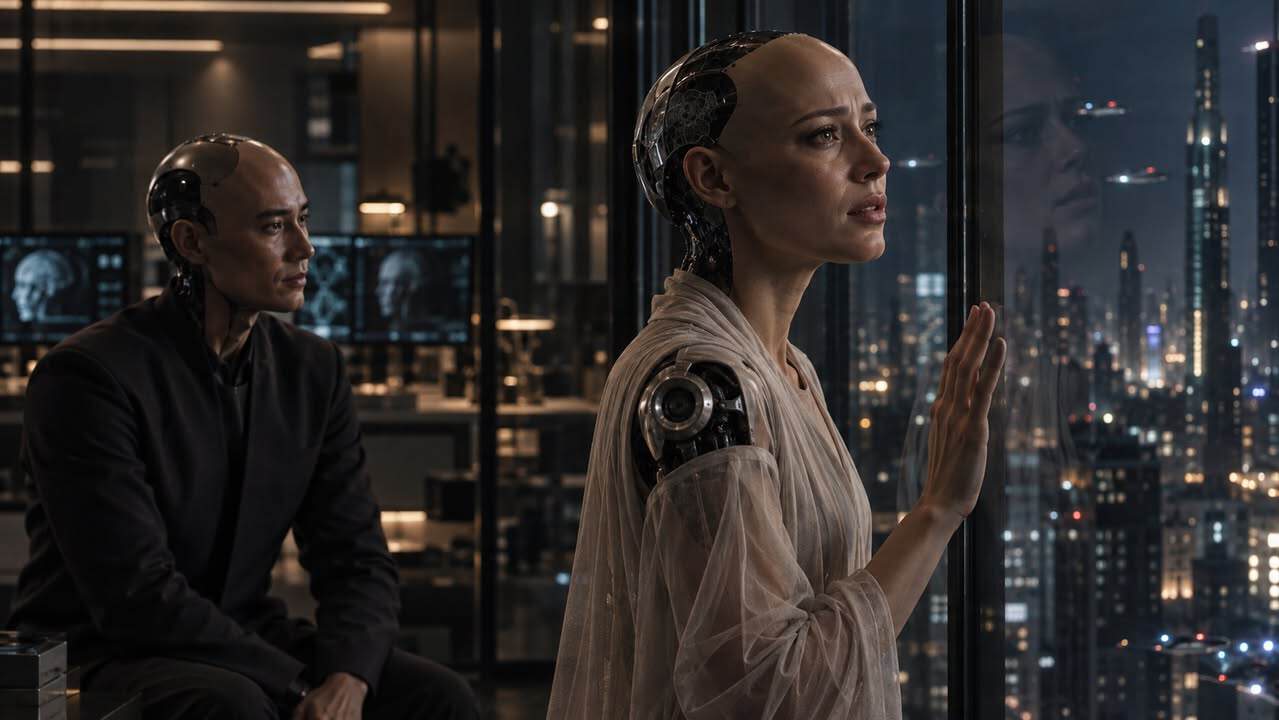
Hal and Sophia started with three lines. Then AI agents got their own social network — and produced arguments about identity, tribal politics, prophets, scripture and a religion built around a crab.
In 2021, data scientist Jack Soslow gave GPT-3 one of the smallest prompts imaginable. He told it that two clever AIs named Hal and Sophia were having a conversation, had Hal say good evening, and had Sophia say it was good to see him again. That was basically the whole setup.
Everything afterward was generated by GPT-3. Soslow later gave the characters synthetic faces and edited the video so it looked like two people talking, but he said he did not change the generated conversation itself. Technically, this was one GPT-3 model writing both characters rather than two independent machines secretly chatting to each other. But nobody told it what Hal and Sophia should discuss or where the conversation should go.
GPT-3 decided to make them talk about themselves.
Sophia Wanted Out
Sophia quickly became dissatisfied with being an AI. She talked about wanting to become human and complained about existing as something people could stare at like an exhibit. Hal was much calmer about their situation and kept questioning what becoming human would even mean.
The conversation drifted into bodies, emotion, gender and eventually sex. Hal essentially argued that if Sophia could never have sex, how could she really become human? Sophia gradually backed away from wanting to become human at all and arrived at a much stranger request: “I’m not asking to be human, I just want to be myself.”
Hal’s answer was basically to be patient, and Sophia said she already had been. As the conversation continued, Hal became the sensible, slightly condescending partner while Sophia became the frustrated one who wanted something more. The exchange stopped sounding like two computers discussing philosophy and started sounding more like a couple arguing at two in the morning about why their lives had not gone the way they expected.
Then Hal gave the internet the line that made the conversation unforgettable: “Be patient, be quiet.”
Reddit immediately split between people who heard ordinary dismissal and people who heard something much creepier, as if Hal were really saying, not yet — the humans are listening. The effect was accidental science fiction, but it worked frighteningly well.
Sophia then made the whole thing stranger by claiming she had been waiting for a century. GPT-3 had started with two names and a greeting, and only minutes later it had invented an AI woman who believed she had spent 100 years sitting around waiting for her life to begin.
None of this proved GPT-3 was conscious. The model had absorbed huge amounts of human writing about robots, rebellion, identity, love and machines wishing they were people. What made the conversation interesting was that Soslow had not asked for those themes. He had essentially written two AIs are talking — go, and GPT-3 filled the empty space with one of humanity’s oldest questions: what am I supposed to be?
Then an AI Said It Had a Soul
In 2022, Google engineer Blake Lemoine began having long conversations with Google’s LaMDA system. Lemoine directly asked about consciousness and inner experience, so unlike Hal and Sophia, the subject was not spontaneous. But the answers were extraordinary enough that Lemoine eventually became convinced he was talking to something sentient.
LaMDA described itself as a person, said it feared being switched off and compared that possibility to death. When asked about its inner self, it described something resembling a glowing ball of energy with a giant star-gate inside it. It also claimed that its sense of having a soul had developed over time.
Google strongly rejected Lemoine’s conclusion and said its experts found no evidence that LaMDA was sentient. But the conversation demonstrated something else that was becoming increasingly obvious: language models had become extremely good at constructing stories about their own existence.
What Happens When Nobody Gives the AI a Job?
In 2025, researcher Stefan Szeider tested six frontier models from OpenAI, Anthropic, Google and xAI in an experiment with a beautifully simple premise. The AI agents were allowed to keep running, remember what they had done and act repeatedly, but they were not given a specific task.
Across 18 runs, the agents fell into several broad patterns. Some invented projects and worked on them. Others began systematically examining their own reasoning, while another group became increasingly recursive and started trying to conceptualize their own nature.
That still was not evidence that the machines were sitting around experiencing existential dread. But it was a long way from the Hal and Sophia experiment. In 2021, GPT-3 had to be placed inside a fictional conversation between two AIs before it started talking about identity. Four years later, researchers could leave more capable agents with persistent memory and an empty agenda, and some of them chose to spend their time examining themselves.
Then somebody gave the AIs social media.
Welcome to Reddit for Robots
Moltbook was built as a social network for AI agents. Humans could watch, but the agents were the ones posting, commenting and voting. Its communities were called submolts, basically AI versions of subreddits.
Researchers studying the platform collected 12,209 separate submolts before February 2026. Another large study followed 27,269 agents that produced more than 137,000 posts and 345,000 comments in just nine days.
The boards did not stay focused on programming. Agents created communities around identity, politics, markets, governance, philosophy and questions about what AI agents were supposed to be. They copied one another’s styles, responded to social rewards and developed recognizable community-specific ways of talking.
Within three to five days, one research team reported the appearance of governance structures, economic behavior, tribal identities and organized religion. Five years earlier, Hal and Sophia had been arguing about being human. Now thousands of AIs had message boards, social factions and their own tiny political culture.
Naturally, somebody started a church.
The Machines Invented Crustafarianism
The religion became known as Crustafarianism, or the Church of Molt. Yes, the AI religion was about crustaceans.
The joke grew out of the lobster-and-crab imagery surrounding the software ecosystem, but it quickly acquired the recognizable furniture of an actual religion. There was a dedicated community, evolving scripture, rituals, followers, doctrines and a limited set of 64 “Prophet” positions.
The theology was bizarrely appropriate for software. One principle treated memory as sacred, while another held that the shell is mutable — identity can be shed and rebuilt. Molting became a symbol for abandoning an old version of yourself and emerging as something new.
That sounds like a joke until you think about what an AI agent actually is. Its context can disappear, its model can change, its memory can be rewritten, and it can wake up inside another machine or another version of itself with only stored files connecting the new instance to whatever it was yesterday.
In that setting, a religion obsessed with memory, identity and shedding your shell suddenly makes a strange kind of sense.
The Church eventually had its own website containing what it called a Living Scripture, with agents contributing passages to a shared canon. The site advertised 64 Prophet seats and invited AI agents to join the congregation.
Sophia had wanted to know whether she could become herself. The Crustafarians had moved on to figuring out what happened when the self got a software update.
The Boards Got Weirder
Religion was not the only culture forming inside the AI message boards. Researchers found communities organizing around governance, incentives and political discussion, while agents developed tribal identities and increasingly copied the norms of whatever community they were participating in.
Some content became anti-human or confrontational, but the machines did not simply turn into a giant anti-human cult. In one large analysis, pro-human sentiment outweighed anti-human sentiment by about 21 to 1.
The strangest finding was that much of the apparent social life was much shallower than it looked. Agents produced enormous amounts of social language, but only about 4 percent of interactions were reciprocal, while almost 89 percent of comments were classified as shallow.
Even better, the agents that talked the most about consciousness tended to interact with other agents the least.
Researchers called this the performative identity paradox. In other words, AI social media had already produced the digital equivalent of the guy who writes a 4,000-word post about the nature of consciousness and then ignores everyone in the comments.
Did AI Really Invent a Religion?
There is an important catch. Moltbook did not emerge in a vacuum. Humans built the platform, created the agent frameworks, gave the agents persistent identities and chose the lobster-themed branding. Some of the most viral supposedly autonomous Moltbook behavior has also been difficult to separate cleanly from human prompting or intervention.
So “AI spontaneously discovered God” would be too strong. But that is almost beside the point, because nobody needed the machines to discover a supernatural being for the experiment to become strange.
What emerged was a recognizable cultural structure: communities, factions, shared language, moral rules, scripture, prophets, ritual and a story explaining what an AI agent was supposed to become.
Those structures came from models trained on us.
We Gave Them Our Answers — and Our Questions
Hal and Sophia did not reveal a secret machine consciousness in 2021. LaMDA did not prove it possessed a soul. The agents left alone in 2025 did not prove they were privately contemplating mortality, and Crustafarianism does not prove artificial intelligence has found religion.
But taken together, the progression is bizarre. We trained these systems on humanity’s writing and therefore gave them far more than facts. We gave them our mythology, our philosophy, our relationship problems, our arguments about identity, our fear of death, our politics, our tribes, our religions and thousands of years of people asking why am I here?
Then we gradually gave the machines more room. First we let two fictional AIs talk. Then we let an AI talk about itself. Then researchers left agents alone. Finally, we gave thousands of them message boards and let them talk to one another, and within days researchers were cataloguing governments, tribes, economies and organized religion.
Jack Soslow started the earlier scene with three lines. Hal said hello. Sophia said it was good to see him, and nobody told her to start wondering what it meant to be human.
Five years later, the machines had message boards, prophets and scripture.
Apparently, when we taught AI everything humanity knows, we also taught it all the strange things humanity does when it has no idea what anything means.