Scientists Took GPT Grocery Shopping. It Had Opinions About 3D-Printed Chocolate.
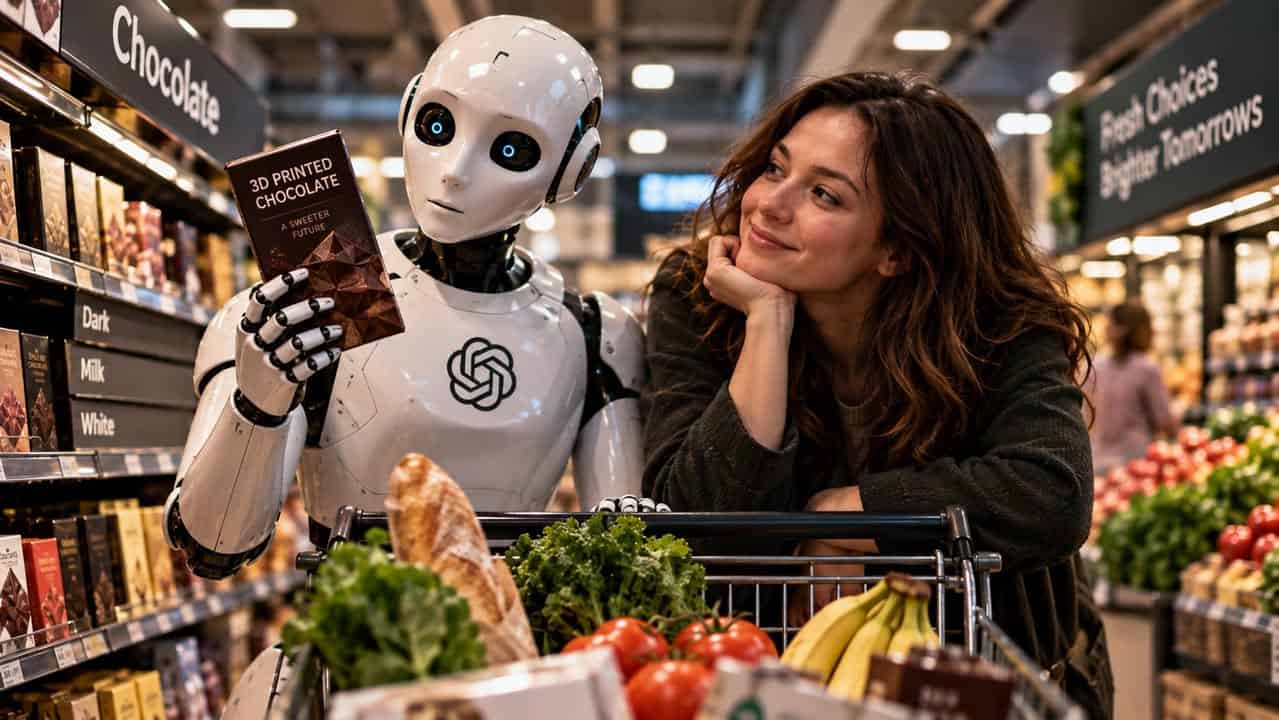
GPT has never tasted chocolate, smelled a tomato or stood hungry in a grocery store. Researchers asked it to shop anyway.
GPT has never tasted chocolate, smelled a tomato or stood hungry in a grocery store. Researchers asked it to shop anyway.
GPT has never eaten chocolate. It does not know what melted chocolate feels like on your tongue, it has never picked up a tomato and decided one looked better than another, and it has never walked into a grocery store hungry and somehow left carrying $40 worth of things that weren’t on the list.
Researchers decided to make it shop anyway. In a 2026 study, scientists gave GPT the same kinds of food choices previously given to real consumers. The shopping list was wonderfully specific: 3D-printed chocolate bars, Italian tomato sauce and fresh tomatoes carrying different labels and certifications.
The question was simple: could a machine that has never tasted anything shop like someone who has?
First Stop: 3D-Printed Chocolate
The chocolate experiment had originally been given to 296 people in the United Kingdom. They chose between bars that differed in price, whether they were white, milk or dark chocolate, and whether they had been made normally or with a 3D food printer.
The human shoppers showed a small preference for the 3D-printed chocolate. GPT had opinions too, but without being given a detailed personality to imitate, it liked the 3D-printing idea much more strongly than the humans did.
Then researchers gave GPT information about individual shoppers and told it to impersonate them. Instead of making it better, the extra detail pushed it too far in the other direction. The personalized version developed a strong preference against 3D-printed chocolate.
The same AI had gone from being more excited about futuristic chocolate than the humans to being considerably more suspicious of it. That was the first clue that GPT wasn’t really shopping the way people shop. It was reading the story around the food.
GPT Understands Cheap
Some parts of human shopping were much easier for the machine. Raise the price and people become less interested; GPT understood that perfectly. Add familiar labels such as organic, Italian origin or other positive environmental claims, and it usually understood those too.
In another experiment involving 868 Italian consumers choosing tomato sauce, GPT came surprisingly close to the overall human pattern. The people liked organic certification, Italian origin and tomato sauce connected with social farming. GPT generally liked those things too and ranked their importance in roughly the same order.
The same broad pattern appeared with fresh tomatoes. Price mattered, certifications mattered, and country of origin mattered. The machine had never bought groceries, but it had apparently read enough about groceries to know how grocery shopping usually works.
The trouble started when food became less like information and more like food.
The AI Has Never Had a French Fry
Chocolate type mattered a lot to actual people. Whether a bar was white, milk or dark accounted for a large part of human choice in the chocolate experiment.
For one GPT condition, it barely mattered at all. The researchers calculated that chocolate type represented about 46 percent of the relative importance in the human choices, but only around 2 percent in the personalized GPT simulation.
That is a huge difference, and it makes intuitive sense. A person knows what dark chocolate tastes like. GPT knows what people have written about dark chocolate. Those are not quite the same thing.
The researchers found that GPT did best with things that can be clearly described in language: price, labels, certifications and broad ideas such as organic production. It struggled more when the choice depended on sensory experience, cultural familiarity or the emotional baggage surrounding a new technology.
GPT understood the price tag better than the chocolate.
Then Scientists Gave ChatGPT French Fries
Another 2026 study pushed the idea further by creating 240 fake consumers with ChatGPT and comparing them with 240 actual people.
This time the food was much less futuristic: french fries. Researchers asked both groups about things such as the shape of the potato, whether it should be deep-fried or air-fried, and what happened when nutritional information entered the picture.
The results were surprisingly close. Both the real people and the ChatGPT consumers tended to prefer thicker-cut fries and deep frying. When nutritional information was shown, both groups shifted somewhat toward the healthier air-fried option.
Across the study, the AI responses lined up with the human results more than 80 percent of the time. But once the choices required more difficult judgments involving nutrition, money or several competing considerations, the AI became less reliable.
It could imitate the broad preference more easily than the messy human being behind it.
AI Eats Its Vegetables
A different study compared GPT-4o and Gemini with 126 human participants making choices between foods based on two things almost everyone understands: health and taste.
The humans cared more about taste. GPT-4o cared more about health. Both GPT-4o and Gemini also showed more successful self-control than the humans, choosing the healthier option more often when taste and health conflicted.
That is not especially surprising. GPT has never smelled french fries from across a room, promised itself it would eat healthy all week, or encountered a cheesecake on Friday night.
It understands temptation because humans have written millions of words about it. It does not have the part where your stomach suddenly gets a vote.
That difference may explain a lot of what is happening in these studies. AI can learn what people say they value without necessarily reproducing what it feels like to value it.
Researchers Tried Giving GPT a Personality
One obvious solution was to give the AI more information about the person it was supposed to imitate. Maybe GPT wasn’t shopping like a 47-year-old Italian woman because nobody had told it that it was supposed to be one.
So researchers supplied demographic and attitude information from real participants and instructed GPT to make choices as those people. It didn’t reliably help.
In the grocery-shopping study, adding detailed profiles sometimes made the AI’s predictions worse. The 3D-printed chocolate result was the clearest example: extra information about the human shopper helped push GPT from liking the new technology too much to disliking it too much.
The persona did not turn the machine into that person. It gave the machine more words from which to build a version of that person.
GPT Is Too Sure of Itself
There was another giveaway: humans hesitate.
Two people with similar tastes can stand in the same supermarket and choose different tomato sauce. The same person can buy one brand this week and another next week because it is on sale, the label looks nice or they simply feel like trying something different.
GPT was much more predictable. Once it decided which features mattered, it tended to choose accordingly with much less of the randomness that appears in actual human behaviour.
To make the AI choices look more like the human data, the researchers had to reduce the strength of GPT’s preferences. In some analyses, its decision strength had to be pushed down to roughly a third of the original level.
The machine knew what it wanted. Humans were messier.
Meet the Synthetic Shopper
This is not merely an amusing way to learn that GPT prefers sensible tomatoes.
Companies spend enormous amounts of money trying to learn what people will buy before putting a product on shelves. That means recruiting consumers, running surveys, testing packaging and asking people whether they would pay another dollar for something labeled organic.
If AI can imitate some of those decisions, researchers can create synthetic consumers: thousands of fake shoppers who can evaluate a product before anybody has manufactured it.
The grocery study suggests there really is something useful there. AI-generated estimates could help researchers design early consumer experiments and identify broad patterns before bringing in real people.
But the same work also shows why replacing actual shoppers would be risky. AI is strongest when the answer lives in language: price, labels, sustainability and familiar product claims.
The further the decision moves toward taste, smell, habit, temptation and cultural experience, the shakier the imitation becomes.
The Machine Knows Everything About Chocolate Except Chocolate
There is something wonderfully strange about asking an AI whether it wants white, milk or dark chocolate.
GPT may have processed more writing about chocolate than any human being could read in a lifetime. It knows recipes, reviews, advertisements, chemistry, manufacturing methods and probably ten thousand arguments about whether white chocolate counts as chocolate.
It knows what humans say about sweetness and bitterness. It knows what people say about biting into a piece of chocolate.
But it has never bitten into one.
That may be why these synthetic shoppers can look remarkably human from a distance. Human preferences leave fingerprints everywhere in language, and AI has spent its entire existence learning those fingerprints.
Get close enough, though, and something is missing.
Researchers took GPT grocery shopping and discovered that it understands prices, labels, organic tomatoes and even some of our feelings about 3D-printed chocolate.
Looks like GPT has already surpassed the average college freshman at the supermarket.