AI Gave Him His Voice Back
ALS took away his ability to speak. Then a computer learned to listen to what his brain was still trying to say.
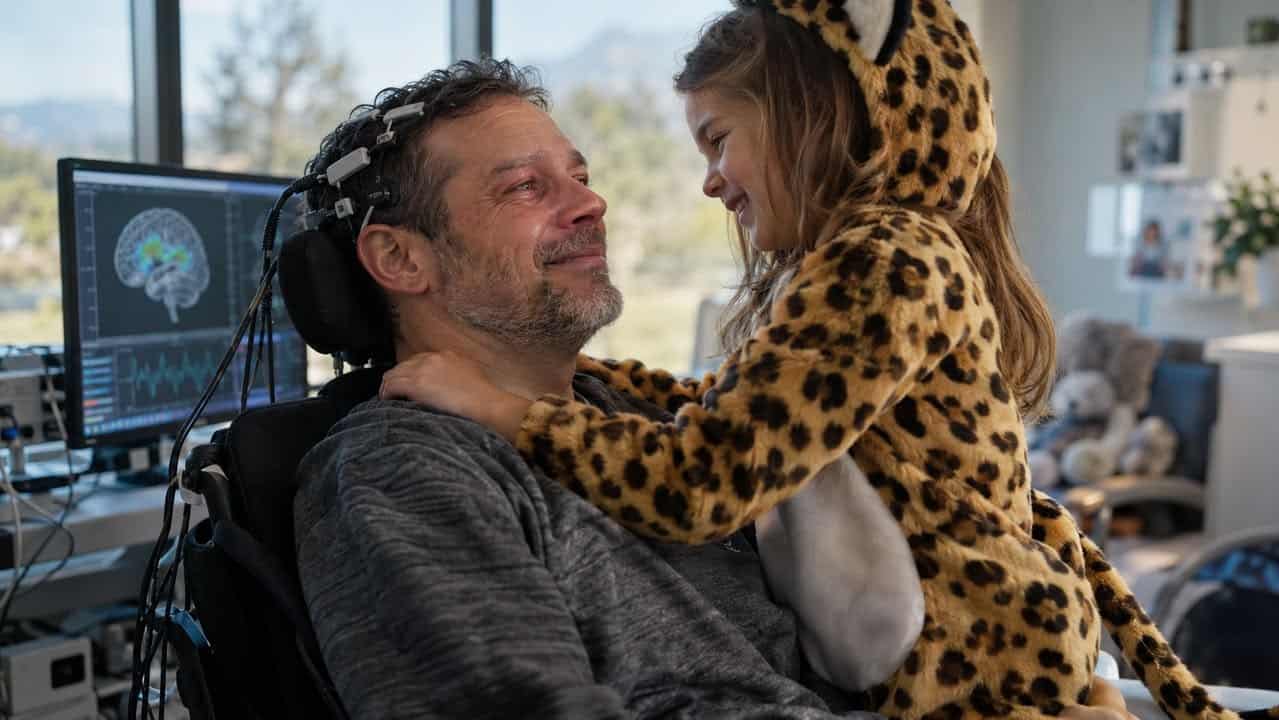
ALS took away his ability to speak. Then a computer learned to listen to what his brain was still trying to say.
A little girl walked into the room dressed like a cheetah.
Her father, Casey Harrell, looked at her and tried to speak. A computer listened to the electrical activity inside his brain, translated it into words and produced a sentence. One of the researchers assumed the machine had screwed up because Casey had apparently said something about a cheetah.
Then everyone looked at his daughter and realized she was wearing a cheetah costume. The machine hadn’t made a mistake. For the first time in years, a father was simply talking to his little girl.
He Was Still Talking. Nobody Could Hear Him.
Casey had amyotrophic lateral sclerosis, or ALS, a disease that gradually destroys the nerve cells controlling muscles. His mind still worked. He still knew exactly what he wanted to say, but the machinery required to say it was failing.
Over several years, conversations became harder. People asked him to repeat himself, and eventually only people who knew him extremely well could understand much of what he was trying to say.
The loss was especially brutal with his daughter. Casey later described losing the ability to sing songs to her, then losing the ability to speak clearly enough for her to understand him. She was still young enough that much of the voice she would remember as her father’s was disappearing before she had a chance to remember it.
ALS hadn’t erased the words in Casey’s head. It had destroyed the road they travelled on, so researchers at UC Davis decided to try building another one.
In 2023, surgeons implanted four tiny arrays containing 256 electrodes into the part of Casey’s brain involved in speech. Then they asked him to try to talk.
His muscles could no longer produce clear speech, but his brain was still sending many of the commands that once moved his lips, tongue and vocal muscles. The researchers trained an AI system to recognize those electrical patterns and turn them back into language.
After about 30 minutes of training during Casey’s first session, the system correctly decoded 99.6 percent of the words he attempted from a small test vocabulary. The researchers then expanded it to 125,000 words, and eventually the system reached about 97.5 percent accuracy, with Casey communicating at roughly 32 words per minute.
When the words started appearing correctly on the screen, Casey cried. So did the researchers.
Then They Gave the Words His Voice
Turning brain activity into text was extraordinary, but text isn’t a voice. A voice carries sarcasm, excitement, annoyance, affection and all the tiny changes in tone that tell somebody what you mean before you’ve even finished the sentence.
So the researchers went further.
They found recordings of Casey speaking before ALS had badly damaged his speech and used machine learning to create a synthetic version of his old voice. Now the thoughts coming from his brain didn’t have to emerge through a generic computer speaker. They could sound more like him.
One of the most powerful moments came when Casey used the system in front of his young daughter and repeated words from his wedding vows to her mother. According to reporting on the experiment, they were among the first clear words his daughter could remember hearing her father say.
The AI wasn’t inventing Casey’s thoughts or writing his sentences for him. Casey formed the words, his brain tried to speak, and the machine simply rebuilt the missing connection.
Eighteen Years Without Her Voice
Casey’s story isn’t the only one.
In 2005, a 30-year-old Canadian teacher known as Ann suffered a catastrophic brainstem stroke. She was married, had a 13-month-old daughter and an eight-year-old stepson, and then almost overnight she became severely paralyzed.
She couldn’t move most of her body or speak, but her mind was still there.
Over the years, Ann slowly regained small amounts of movement. She could laugh, cry, wink and move her head, but her voice never returned. Her daughter grew up knowing her mother’s everyday “voice” largely as the computerized British accent produced by her communication device.
She barely knew what her mother had actually sounded like because Ann had been silenced when her daughter was one.
Nearly two decades later, researchers at UC San Francisco and UC Berkeley implanted 253 electrodes over the regions of Ann’s brain involved in speech. She tried to talk, and the AI learned the patterns.
In 2023, researchers reported in Nature that the system could translate her attempted speech at a median rate approaching 80 words per minute. It could also control a digital face, moving its mouth and expressions in ways designed to make communication feel less like operating a machine.
Then researchers went looking for Ann’s old voice and found it in her wedding video. Recordings from before the stroke were used to build a synthetic voice resembling the woman her daughter had barely had time to know.
When Ann heard it, she said it felt like hearing an old friend. Her daughter had grown up, while her mother’s voice had been waiting on a videotape.
The Brain Doesn’t Necessarily Forget How to Talk
At Stanford, researchers found something just as remarkable.
Pat Bennett also had ALS, and the disease had attacked her ability to speak particularly hard. She eventually became unable to produce intelligible speech even though she could still think normally.
Researchers implanted four tiny arrays into speech-related areas of her brain and spent months recording what happened when she attempted thousands of sentences.
In 2023, they reported in Nature that her attempted speech could be decoded at 62 words per minute using a vocabulary of 125,000 words.
The important part wasn’t only the speed. The brain patterns for speech were still there even though the muscles had failed. After years of losing the ability to speak, Pat’s brain was still producing detailed information about the sounds she was trying to make.
After one successful session, Pat summed up the breakthrough better than any research paper could: “Holy shit, it worked.”
Then the Voice Stopped Sounding Like a Machine
There was still a problem because conversation depends on timing. If you have to wait several seconds every time you want to answer someone, the conversation keeps moving without you. The joke is over, the subject changes and somebody else starts talking.
You can technically communicate, but you’re not really part of the rhythm anymore.
In March 2025, researchers from UCSF and Berkeley reported another major step. Instead of waiting for an entire sentence to be decoded before producing speech, their system processed brain activity in tiny 80-millisecond pieces.
The result was streaming speech. Ann silently attempted to talk, and the artificial voice began speaking almost alongside her thoughts. The larger-vocabulary system reached about 47.5 words per minute, while a smaller vocabulary exceeded 90 words per minute, with delays of less than a quarter of a second.
The machine was starting to behave less like a typing device and more like a replacement voice box.
Another 2025 Nature study pushed even further. Researchers used 256 implanted electrodes in a man with ALS and generated speech directly from his attempted speech activity.
The system didn’t only recover the words. It also recovered some of the way he was trying to say them. He could change his intonation, emphasize particular words and even produce short sung melodies.
The question was changing from simply figuring out what word a person was trying to say to something much more human: how were they trying to say it?
Then Casey Took It Home
There was still one enormous catch. Most of these systems were spectacular laboratory demonstrations, and a spectacular laboratory demonstration isn’t much use if a room full of researchers has to stand beside you every time you want to talk to your family.
Then came 2026.
Researchers reported in Nature Medicine that Casey had been using his brain-computer interface independently at home for nearly two years. Over that period, he logged more than 3,800 hours of use, operated it on hundreds of days and produced 183,060 sentences containing almost two million words.
His average communication speed climbed to roughly 56 words per minute, and in controlled testing the system surpassed 99 percent accuracy using a vocabulary of 125,000 words.
Casey used it to talk with his family, send messages, write emails, browse the internet, join video calls and control his computer. He continued working full-time and sometimes used the system for more than twelve hours in a day.
At some point, this stopped being a science experiment and became part of a life.
That’s what makes the nearly two million words so remarkable. They weren’t two million scientific words. They were work conversations, questions, jokes, arguments, parenting and probably an enormous amount of completely pointless everyday crap.
Exactly the kind of things a voice is supposed to be used for.
The Most Important Thing AI May Ever Say
Most conversations about artificial intelligence are about what machines might do instead of us. AI will write the email, create the picture, drive the car or take the job.
This is different because here, the best version of the technology is the one you eventually stop noticing.
A daughter shouldn’t have to think about neural electrodes, machine learning or speech decoding when her father tells her he loves her. She should just hear her dad.
A husband should be able to annoy his wife. A mother should be able to tell a bad joke. Someone should be able to interrupt, complain, laugh, sing or say something stupid and immediately wish they could take it back. That’s speech.
For most of human history, if disease destroyed the bridge between a functioning brain and a functioning mouth, there wasn’t much medicine could do about it. Now we’re starting to build around the damage.
These systems are still experimental. They require brain surgery, have been tested in relatively few people and remain far from something most patients can simply receive at a hospital.
But the direction is getting difficult to ignore. First the computer found the words, then the voice, then the timing, then some of the emotion, and eventually researchers sent it home.
Somewhere in California, a little girl walked into a room dressed like a cheetah. Her father looked at her. His body could no longer speak clearly, but his brain tried anyway.
And this time, something was listening.