
AI Can Hear Parkinson’s While You Sleep
Years before the tremor, the body may already be whispering that something is wrong.
Years before the tremor, the body may already be whispering that something is wrong.
Before the first tremor
One night you go to bed feeling completely normal. No shaking, no stiff hands, no trouble walking. You fall asleep, and a small device across the room quietly watches your breathing using radio waves. It never touches you, and you don’t have to wear anything. But by morning, the machine may have noticed something about your brain that you haven’t.
Researchers at MIT built an AI system that studies the way people breathe during sleep and looks for patterns linked to Parkinson’s disease. The strange part is that it doesn’t need to watch someone move. It can find clues just from the pattern of their breathing.
Parkinson’s usually shows up late
Parkinson’s is often diagnosed after symptoms such as shaking, stiffness and slow movement begin. By then, the disease may have already been developing quietly for years. Researchers wanted to know whether the body might be giving off earlier clues, and breathing turned out to be one place worth looking.
Parkinson’s can affect parts of the brain involved in breathing, so the MIT team studied nighttime breathing from thousands of people. Some wore breathing belts, while others simply slept near a small radio device that worked a little like Wi-Fi.
The device sent out weak radio signals and measured tiny movements in the chest as people breathed. AI then searched those patterns for changes a human would probably never notice. Using one night of data, the system could identify many people with Parkinson’s, and with several nights of data it performed even better. It could also estimate how severe the disease was and track changes over time.
Then researchers looked at older sleep recordings from some people taken before they had been diagnosed. The AI was able to flag many of them, suggesting the disease had been leaving clues before anyone knew what those clues meant.
Then AI started hearing it in the voice
Breathing isn’t the only place those clues can hide. Parkinson’s can also change the voice before the difference becomes obvious to friends, family or even the person speaking.
Researchers have used short smartphone recordings to find tiny changes in pitch, pronunciation and speech patterns linked to Parkinson’s and related diseases. A human listener might never hear those changes, but AI can search through thousands of tiny details at once.
The brain leaks clues into speech
Researchers have tried the same idea with Alzheimer’s disease. AI systems can study short voice recordings and look at pauses, word choice, sentence structure and how much useful information someone packs into their speech.
They aren’t waiting for somebody to forget their own name. They’re looking for much smaller changes, such as longer pauses, different word patterns and tiny shifts in how someone puts a sentence together. The brain may be starting to struggle before anyone around the person realizes it.
Then they gave AI an entire night
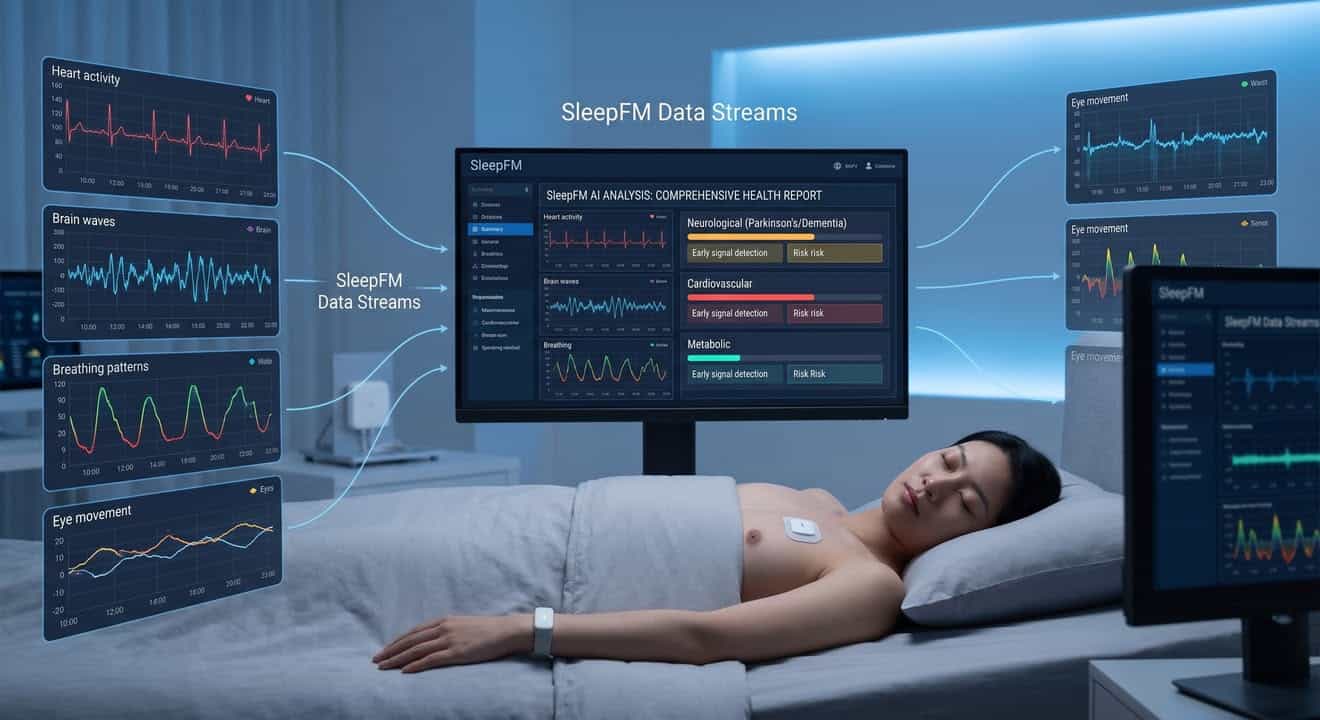
By 2026, researchers were looking at something much bigger than Parkinson’s. A system called SleepFM was trained on hundreds of thousands of hours of sleep recordings.
A sleep study collects far more than snoring. It can record breathing, heart activity, brain waves, eye movement and muscle activity. To a doctor, that’s a huge amount of information to sort through. To AI, it’s a giant collection of patterns.
One night, more than 100 diseases
Researchers asked whether one night of sleep could reveal anything about future health. The system found signals linked to more than 100 health conditions, including Parkinson’s, dementia, heart problems and stroke.
That doesn’t mean one night of sleep can tell you exactly what disease you’re going to get. It means your body may be giving off small warning signs long before the obvious symptoms appear.
The body whispers first
Medicine usually waits for the body to complain. A tremor starts, memory gets worse, chest pain appears or breathing becomes harder. Something finally becomes obvious enough that a person goes to a doctor.
AI could change that order. Instead of waiting for the big symptom, it can look for thousands of tiny changes that were already there, such as a slightly different breath, a longer pause between words, an unusual change in sleep or a small shift in heart activity.
None of those signals means much by itself, but thousands of them together can form a pattern. AI happens to be very good at finding patterns that humans would never notice on their own.
The checkup could come before the symptoms
Imagine a future where you don’t go to the doctor because you feel sick. You go because your watch, phone or bedroom sensor noticed that something has slowly changed.
Maybe your breathing is different, your voice has shifted or your sleep isn’t quite the same. That wouldn’t mean you definitely have a disease. It might simply mean it’s time to take a closer look.
For diseases like Parkinson’s, that could matter a lot because by the time the shaking starts, the disease may have already been developing for years. If AI can notice those earlier whispers, doctors may eventually get a chance to act sooner.
While you’re sleeping
You spend about a third of your life asleep. During that time, your lungs keep breathing, your heart keeps beating and your brain keeps moving through different states. For most of history, nearly all of that information simply disappeared into the night.
Now AI can watch those signals without needing you to shake, forget something or even wake up. Sometimes the body starts telling the story years before we realize anything is wrong.
Hopefully we can actually cure these diseases soon rather than just detect them.