He Went Blind. Then He Built an AI So His Sister Could See.
When nobody built the tool Mark and Karen needed, Mark taught himself to code and built it himself.

When nobody built the tool Mark and Karen needed, Mark taught himself to code and built it himself.
Karen Morad was 16 when she went on safari in Kenya in June 2026. There was one fairly serious problem with going on safari: Karen couldn’t see the animals.
She had been completely blind for about five years. Normally, much of the visual world around her had to reach her through somebody else. A person could tell her what was nearby, explain what everyone was looking at or describe an animal moving in the distance. She could experience the moment, but somebody else usually had to translate it first.
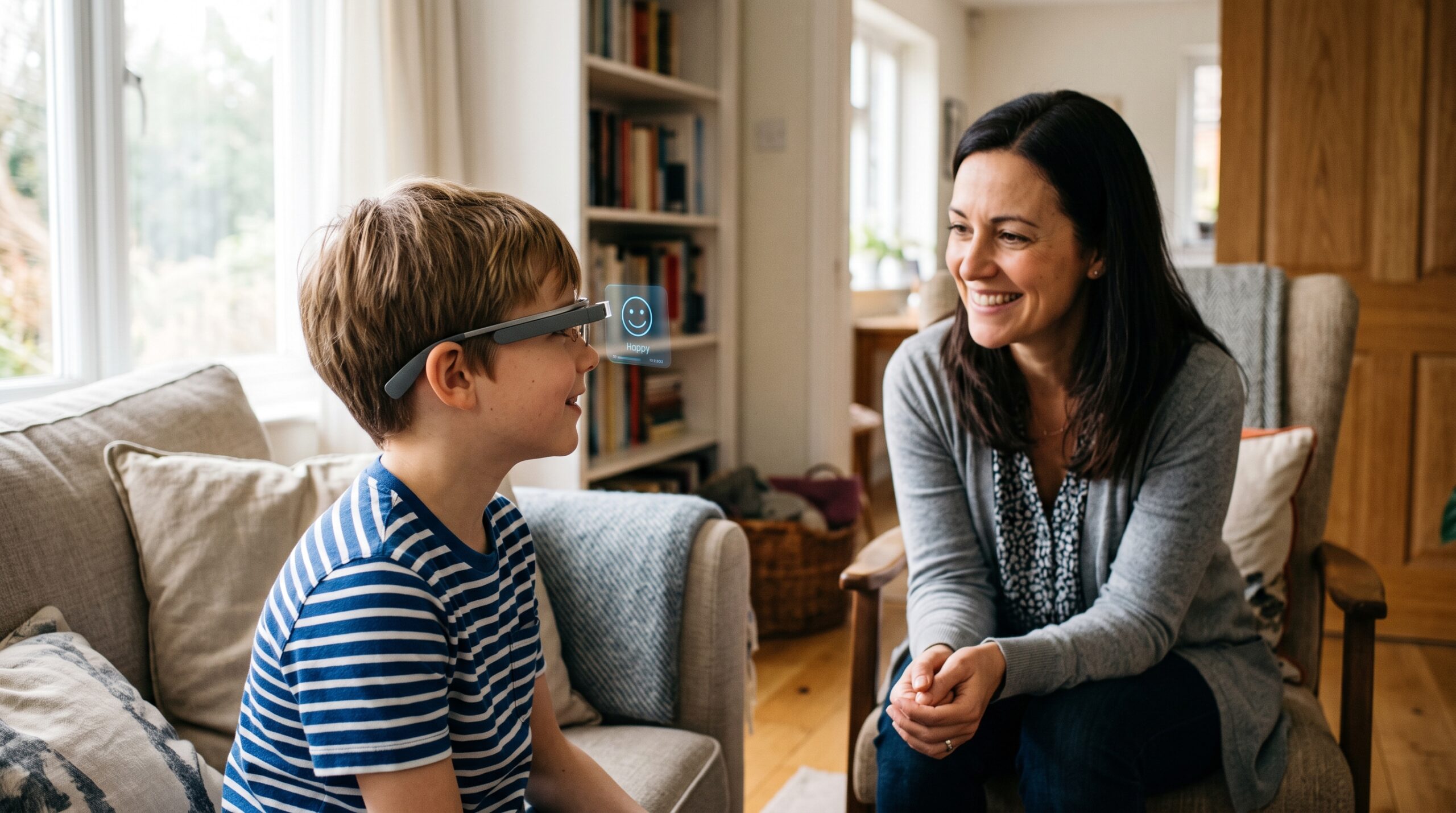
This time, Karen was wearing smart glasses running an AI app built by her older brother. As the safari moved around her, the glasses described what was happening. They could tell her about the animals, roughly how far away they were and what they appeared to be doing. Instead of receiving one description from somebody sitting beside her, Karen could keep asking questions as the scene changed.
Later, she said she had always thought something like this would be impossible. Then she found herself sitting in Kenya, surrounded by wildlife she couldn’t physically see, while a computer translated enough of that world into words that she could begin building the scene inside her head. For a moment, she said, it felt like she could see.
The person who built the system understood exactly why that mattered, because Mark Morad was blind too.
First Mark Lost His Sight
Mark began having problems with his vision in 2018. Doctors eventually determined that he had a rare and incurable condition affecting his optic nerves. They could tell him that he was going to lose his sight, but they couldn’t tell him exactly when it would happen.
Then his younger sister Karen began losing hers as well. Karen’s vision disappeared in roughly six months. Mark’s decline stretched across almost three years. By late 2021, both siblings were completely blind.
Their mother, Marian Maurice, didn’t know what to do. Reuters reported that she would sometimes tell the family she needed to run an errand, leave the house and cry by herself before returning home.
Parents spend years imagining what their children’s lives might look like: school, careers, travel, independence. Then suddenly two of your children are losing their sight at the same time, and nobody can tell you how to stop it.
The Computer Would Just Stop
The family had to rebuild ordinary life around blindness, and for Mark, one of the first places where the cracks became obvious was school.
Screen readers are incredibly useful when information is made mostly from words. Mark’s problem was that he wasn’t studying only words. He was studying physics and chemistry, where textbooks contained diagrams, graphs, equations and visual relationships that ordinary screen readers often couldn’t properly explain.
The software might read the paragraph describing a problem and then become almost useless when it reached the part of the page that actually made the problem understandable.
Mark contacted developers who were already working on accessibility tools, hoping somebody might have a solution. When he didn’t get the help he needed, he decided to try building one himself.
He taught himself programming by listening to YouTube tutorials. By 2023, while still a teenager, he had a working version of an app that eventually became ScribeMe. The original idea was straightforward: help a blind person understand things that traditional screen readers couldn’t. Then AI systems suddenly became much better at understanding images, and Mark’s little accessibility project gained an entirely new set of possibilities.
The Camera Became a Pair of Eyes
Modern multimodal AI can do much more than recognize that a dog appears in a photograph. It can describe where the dog is standing, what it seems to be doing, what objects are nearby and answer follow-up questions about the scene.
If you can already see the photograph, that can feel like a clever feature. If you can’t see it, the difference is enormous.
ScribeMe lets someone point a phone camera at the world and ask questions about what’s there. It can scan documents, describe surroundings and provide information about a scene in real time. Mark also made Arabic support a priority after finding that many competing accessibility tools didn’t handle it particularly well.
The app now supports 20 languages and is used by thousands of people across roughly 140 countries. It can also work through Meta smart glasses, which removes another small but important barrier: a blind person doesn’t have to hold a phone in one hand while trying to use a cane with the other.
The technology stops being something you pull out of your pocket and becomes something that can stay with you while you move through the world. For Karen, that can mean finding her classroom, recognizing shops, choosing clothing or studying. In Kenya, it meant she could sit on safari and understand what was happening around her without waiting for somebody beside her to describe every new thing.
Her eyes hadn’t been cured and the animals hadn’t changed. What changed was how much of the world she could reach on her own.
A Father Read His Daughter a Book
The same technology becomes even more powerful when the story gets smaller.
In 2025, Be My Eyes CEO Mike Buckley told the story of a blind father named Robbie who used smart glasses connected to Be My Eyes to read a book to his two-year-old daughter for the first time.
On paper, that doesn’t sound like a major technological breakthrough, and that’s exactly why it matters. A father wanted to sit beside his little girl and read her a story. For most parents, the difficult part is convincing a two-year-old to stay still long enough to finish the page. For Robbie, the page itself was the barrier.
The glasses changed that. A camera could see what he couldn’t, while technology translated that visual information into something he could use. His hands stayed free for the book and for his daughter.
That is the point where accessibility technology stops feeling like a gadget. Nobody sitting in that room cares how impressive the computer-vision model is. They care that Dad gets to read the bedtime story.
Two Brothers Started Asking the World Questions
Bradford and Bryan Manning know the same kind of friction. Both brothers have Stargardt disease, an inherited eye condition that has taken much of their central vision. In 2016 they founded Two Blind Brothers, an organization and apparel company that raises money and awareness for blindness research.
They have also started using AI for remarkably ordinary tasks. Bradford can point a camera at money and check whether he was handed the correct bill. The brothers can use AI to read restaurant menus. Bradford can ask what is around him while navigating parts of New York City. At work, information buried inside spreadsheets and documents can be turned into something he can ask questions about instead of manually magnifying and moving through it piece by piece.
None of those examples sounds particularly dramatic by itself. Together, they reveal something important about blindness. Tiny tasks can become negotiations: is this the correct bill, what’s on this menu, which port is on the back of this computer, what exactly is in front of me?
For years, many of those questions quietly carried another question behind them: who do I need to ask for help? AI increasingly changes that question into something simpler: what do I want to know?
For someone who can see, the difference may sound small. For someone who can’t, it can mean another little piece of independence returned.
Sometimes the AI Isn’t Enough
There is another important part of this story: AI doesn’t always have to replace the person helping.
Be My Eyes originally became popular by connecting blind users with sighted volunteers over video calls. A blind person could point a phone camera at something, and another human being somewhere in the world could describe what they saw.
AI didn’t destroy that network. It became another option beside it. Today, users can choose between automated visual assistance and human volunteers. Through smart glasses, someone can connect hands-free when a situation needs an actual person rather than another machine-generated answer.
One user described using the glasses while working on a new computer. He needed help changing BIOS settings, exactly the kind of visually dense screen where confidently guessing the wrong thing could cause a real problem. A volunteer could see what the glasses saw and guide him through the process while both of his hands remained free.
Another user described getting help while playing video games, with a volunteer explaining where he was and how his in-game camera was positioned.
That may be a better picture of where this technology is going. Sometimes you want AI to tell you which cereal box you’re holding. Sometimes you want another person who can understand the weird thing happening in front of you. The useful part is being able to choose.
AI Is Becoming a Second Set of Eyes
Blind filmmaker James Rath uses AI glasses in yet another way.
He can ask them about his camera setup, check whether something unwanted is sitting in the background of a shot or find out what his guide dog Hoagie is doing. Instead of stopping his work and finding another person to inspect the scene, he can get an answer while he is still working.
It is a different kind of independence from Karen experiencing a safari or Robbie reading to his daughter, but the underlying idea is the same. The technology doesn’t restore sight. It restores access to information that sighted people receive almost automatically.
Walk into a room and you immediately know whether the lights are on, whether a chair is blocking your path, whether your dog is sleeping beside the door or whether the shirt you grabbed from the closet is blue. Sighted people rarely think of those things as information. They simply know them because the information arrives continuously through their eyes.
Blindness makes it obvious how much daily life depends on thousands of tiny visual facts. AI is beginning to translate some of those facts into another form.
Researchers Are Trying to Go Even Further
The idea isn’t limited to commercial smart glasses. Researchers are experimenting with wearable systems that combine AI with audio and touch to help blind and low-vision users understand unfamiliar environments.
A 2025 Nature Machine Intelligence paper described a wearable visual-assistance system designed around the needs of real users instead of simply attaching object recognition to a camera and calling the job finished.
Another 2025 project called VIPTour used AI to help blind and low-vision participants explore unfamiliar environments and build a mental picture of what surrounded them. Researchers reported improvements not only in navigation but also in emotional response and later memory for the places participants experienced.
That matters because seeing isn’t just about avoiding a chair. It’s also how people experience places. A mountain isn’t merely an obstacle sitting a certain number of metres away. An elephant on safari isn’t just a large object detected in the distance. Places have shape, movement and context. We remember where things were, what happened around us and how being there felt.
Technology capable of describing a world well enough for someone to build their own mental picture of it is doing something more interesting than object detection. It’s beginning to turn information into experience.
Then Karen Went on Safari
Karen Morad wasn’t sitting in a laboratory testing a prototype. She was a teenager on vacation. Animals were moving around her, the landscape was changing, and her brother’s software was describing enough of what was happening that she could build the scene in her mind while it unfolded.
Only a few years earlier, their mother had been leaving the house so her children wouldn’t know she was crying. Mark had been sitting in school with software that could read the words in his chemistry lesson but couldn’t properly explain the diagram that made those words meaningful.
He asked developers for help and didn’t get what he needed, so the blind teenager learned to code and built something himself. His sister started using it. Other blind people started using it. Eventually thousands of people were using it across roughly 140 countries.
Mark and Karen’s father later told Reuters that if somebody had predicted where his children would be four years earlier, he would have laughed. The family had apparently stopped being so quick to call things impossible.
Maybe That’s What the Good Version of AI Looks Like
A lot of AI stories are about replacing something: a worker, a writer, a search engine or another piece of human interaction.
This story is different because the technology isn’t interesting for what it removes. It’s interesting for what it gives back.
It gives a student access to the diagram everybody else can already see. It gives a filmmaker another way to frame his shot without stopping to find somebody else. It lets someone check the money in his hand without asking a stranger. It lets a father sit beside his daughter and read her a bedtime story.
And it let a blind 16-year-old girl sit in Kenya while elephants moved through the landscape around her and understand enough of that scene to feel, for a moment, like she could see.
Not because AI fixed her eyes, but because it found another way for the world to reach her.